Hyperboloid Contact Technology
Smiths Interconnect offers an extensive range of superior contact technologies suitable for standard and custom solutions.This is the original superior performing hyperboloid contact technology designed for use in all applications and in harsh and demanding environments where high-reliability and safety are critical. The inherent electrical and mechanical characteristics of the hyperboloid contact ensures unrivalled performance in terms of reliability, number of mating cycles, low contact force and minimal contact resistance. The shape of the contact sleeve is formed by hyperbolically arranged contact wires, which align themselves elastically as contact lines around the pin, providing a number of linear contact paths.
Hyperboloid Contact Technology Products
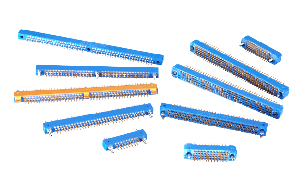
KA Series MIL-DTL-55302
Compliant PCB Connector
Designed and developed for rugged applications in the military, aerospace and commercial aviation markets.

L Series High-density
Modular Connector
High-density, modular, rack and panel connector solutions that includes coax and high-current contacts up to 25 amps, and allows for up to 900 contact positions.
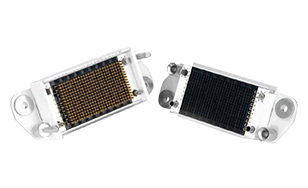
N Series High-density
Mini-modular Connector
High-density, modular, rack and panel connectors that include coax and high-current contacts up to 200 amps, as well as the patented Hot Plug contact.
Hyperboloid Contact Technology Features and Benefits
Features
Low Insertion/Extraction Forces
The angle of the socket wires allows tight control of the pin insertion and extraction forces. The spring wires are smoothly deflected to make line contact with the pin.
Long Contact Life
The smooth and light wiping action minimizes wear on the contact surfaces. Contacts perform up to 100,000 insertion/extraction cycles with little degradation in performance.
Lower Contact Resistance
The design provides a far greater contact area and the wiping action of the wires ensures a clean and polished contact surface. Our contact technology has half the resistance of conventional contact designs.
Higher Current Ratings
The design parameters of the contact (e.g., the number, diameter and angle of the wires) may be modified for any requirement. The number of wires can be increased so the contact area is distributed over a larger surface. Thus, the high current carried by each wire because of its intimate line contact, can be multiplied many times.
Immunity to Shock and Vibration
The low mass and resultant low inertia of the wires enable them to follow the most abrupt or extreme excursions of the pin without loss of contact. The contact area extends 360 degrees around the pin and is uniform over its entire length. The 3 dimensional symmetry of the hyperboloid contact design guarantees electrical continuity in all circumstances.
Benefits
High-density Interconnect Systems
Significant reductions in size and weight of sub-system designs. No additional hardware is required to overcome mating and un-mating forces.
Low Cost of Ownership
The hyperboloid contact technology will surpass most product requirements, thus eliminating the burden and cost of having to replace the connector or the entire subsystem.
Low Power Consumption
The lower contact resistance of our technology results in a lower voltage drop across the connector reducing the power consumption and heat generation within the system.
Maximum Contact Performance
The lower contact resistance of the hyperboloid contact reduces heat build-up; therefore hyperboloid contacts are able to handle far greater current in smaller contact assemblies without the detrimental effects of high temperature.
Reliability Under Harsh Environments
Harsh environmental conditions require connectors that will sustain their electrical integrity even under the most demanding conditions such as shock and vibration. The hyperboloid contact provides unmatched stability in demanding environments when failure is not an option.