Removing Wires, Increasing Performance
Wireless Charging - An Automotive Expectation
by Frank Sholz
Molex Product Manager, Wireless Charging
According to a Mobility Report from Ericsson*, there will be 7.2 billion smartphone users by 2023. This means that almost 90% of the world’s population in the next few years will have a mobile phone in use.
Today most people cannot even imagine driving without their smartphones. Recent studies show that 7 out of 10 people use their smartphone while driving.
Most people today cannot imagine driving without their smartphones. Recent studies show that 7 out of 10 people use their smartphone while driving. Beyond placing a call, mobile phones deliver more functionality than ever before. Cell phones offer GPS navigation, infotainment (podcasts, internet radio and playlists) options, voice-controlled texting, customization of vehicle setting (air conditioning and seat positions), as well as data transfer with the cloud. They are also essential for using apps from the vehicle manufacturer. The use of cell phone and other mobile devices is so prevalent that many car manufacturers now offer WiFi in the vehicle.
This mass expansion of cell phone usage requires a significant amount of send/receive data, and the more data a phone transfers, the shorter the battery life. In addition to the increased use of WiFi-connections and apps, the enhanced physical size and quality of displays drain batteries faster than ever. Ten years ago, a fully charged cellular phone battery would last around a week. Today, the average battery life for a smartphone is one day. And this doesn’t even account for the expansion of LTE and LTE-Advanced networks that utilize more power than ever before.
The continuous usage of a smartphone during daily life requires more power, increasing the risk of experiencing a dead battery. This makes vehicle charging an even more important event in the daily life of consumers.
A Proven Technology
Charging a smartphone in the car is a truly antiquated and inconvenient process – connectors do not always fit, adapters can be lost, cables get tangled, connecting while driving can be a dangerous undertaking, and the charging capacity of the USB connector is low.
The obvious solution is a technology that the inventor and visionary Nikola Tesla had already demonstrated in 1891: the wireless “inductive” transfer of energy for lighting incandescent bulbs.
Inductive charging – as in the wireless transfer of energy between an electric toothbrush and its base station, for example – converts an input voltage into a constant output voltage, the same way a standard combinatorial circuit component functions.
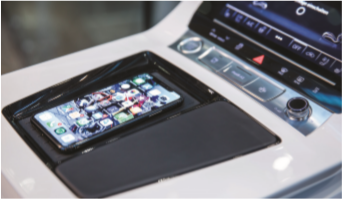
The key difference is the power supply unit: the wound coils used in the power supply unit are installed separately in wireless charging. A magnetic field is created from a precisely defined frequency between 105 kHz and 205 kHz via the coils in the transmitter modules; the coils in the receiver devices receive electrical power with the identical frequency and generate voltage that charges the device’s battery.
Challenges
The development and implementation of wireless charging systems does not come without significant design challenges. Electromagnetic compatibility (EMC) requirements in automotive applications are stringent, and rightly so. EMC is the unintentional generation, broadcast and reception of electromagnetic energy that can
cause unwanted effects on an electrical system such as electromagnetic interference (EMI).
Wireless charging can have a negative influence on the KeyFob system by generating these unwanted electromagnetic fields that interfere with KeyFob performance. With the evolution of the KeyFob system to now include vehicle door lock/open, trunk open/close, and critical remote engine start, it is vital that a wireless charging system does not emit EMC that interferes with the keyless go system. The design challenge is intensified when the driver places the KeyFob on or near the wireless charging station. For example, when the KeyFob is on the wireless charging station/ platform during charging, the vehicle couldn’t find the KeyFob signal, and thus the car would not start or operate. The development of advanced EMC shielding techniques is essential to ensuring the coexistence of the wireless charging system with KeyFob and other critical car key communications.
Extreme temperatures not only have an adverse effect on a mobile device but on the wireless charging station as well. The typical operating temperature for a cell phone is 0° C to 35° C. The interior of a vehicle sitting in a sunny parking spot during the summer can reach well beyond 37° C. During a winter day, the temperature can reach well below 0° C. When not appropriately designed and protected, these drastic temperature changes throughout the year can lower the performance of the charging system, and cause damage that renders it inoperable.
EMC and temperature fluctuations can also affect the efficiency of the wireless charging system. When transferring power from the platform to the phone, some energy will inherently be lost; however, many wireless charging systems can only achieve efficiencies of around 45% under perfect conditions. EMC shielding and thermal management play an important role in increasing the energy efficiency of the system.
Wireless charging modules’ charging times are also dependent on the distance between the transmitter and the receiver module. Molex has designed units to bridge distances up to 4 millimeters. Greater distances are possible, but only at a higher transmitting power level, which in turn would negatively affect the critical electromagnetic compatibility (EMC) in a closed vehicle. The EMC value indicates the undesirable fact that technical devices disrupt each other through electrical or electromagnetic effects.
With thousands of distinct smartphone models in existence worldwide, there is no single wireless charging design that can affectively power every model. The battery area on many of these phones is different, and the wireless charging system must be able to work with every version, no matter what the phone position is on the charging station.
In addition, every vehicle interior is very different, including ergonomic design and electronic functionality. The need for a single platform that is easily and cost-effectively customizable to meet every vehicle’s specific design requirement is mandatory.
A More Efficient Solution
Wireless charging modules are almost never equipped with identical components; their efficiency in transferring power to the receiving device varies with the components used and the expertise regarding the design and build.
The latest Molex wireless charging modules for the automotive industry are highly efficient compared to the other systems on the market. The Molex design offers efficiency up to 62% (battery of the car to battery of the smartphone) at 5W with a range of 4mm between the TX coil (WCh) or the RX coil (smartphones). “Today, we have virtually no extra losses compared to cable connectors,” says Frank Scholz, product manager, Molex. “Charging a smartphone via a cable or wirelessly through inductive charging basically takes the same amount of time.” This is achieved through a patented EMC shielding design and temperature management systems.
The wireless charging operates by using the magnetic field; however, there is an electrical field present too. One depends on the other. To meet the automotive industry’s stringent EMC requirements there is a need to reduce the electrical field below the limits. The system utilizes Litz wire coils and an industry standard charging controller. A unique power stage driver and switch design combined with an innovative EMC shield and protected input circuitry enables the system to exceed automotive EMC requirements. In addition, the EMC shield is connected directly to the antenna board to increase reception/ transmitting of GSM, UMTS and LTE signals in all horizontal positions of the phone. By combining its wireless charging solution with antenna coupling, Molex offers additional functionality to increase quality of service (QoS) and enhance the user experience. Temperature sensors on the surface of the board measure the surface temperature of the module. This provides FOD (foreign object detection). A special heat sink has a contact to the wireless charging coils and is responsible for passive cooling of the module.

A Smarter Solution
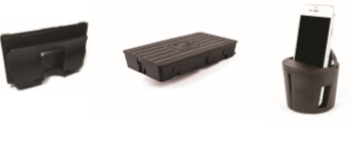
Molex offers a smarter wireless charging unit which has an integrated wireless charging controller. During the charging process e.g. for 5W precisely 5 volts are available at a maximum of 1 amp of current on the phone’s battery site. Molex Wireless Charger offers the same performance as a standard charging cable. If the battery is fully charged, or if the phone is removed, the charging shuts off automatically. In the case that the end user smartphone is not compatible with the Qi standard, the system switches off immediately and protects the phone form any interference. Molex also offers a cup holder solution that can be bought as an accessory by the OEM dealer.
Customized Configuring
“Our cooperation with the development divisions of the manufacturing companies naturally starts long before mass production begins,” says Frank Scholz. “This is because there are very specific requirements depending on vehicle type and the model’s interior.”
For this reason, Molex wireless charging modules are supplied in the vehicle-related configuration defined by the automobile manufacturers. All Molex products are individually designed and developed on the Molex Wireless Charging platform; the form may vary depending on the requirements of the product designers. For vehicle manufacturers, completed modules are delivered to match the OEM’s design in the desired size and with a receiving slot for the smartphone.
These plug-in units are designed for installation in the central console and are fitted with a connector for system and power supply via the CAN Bus as well as with a coaxial connection to the upstream Compenser® (antenna amplifier).
For the latest limousines from another manufacturing company and for future vehicle lines, however, a visually matching inductive area (pad) is constructed below the center armrest or center stack, where the respective smartphone can rest safely. Electronic components and connectors are placed in this construction below the induction area. This build is also fitted with the same proven antenna coupling and the Compenser®.
A Growing Technology
Wireless charging is seen as a commodity in the automotive sector. The vehicle is perceived as a living space, and for 2.6 billion people, smartphones have become an indispensable companion in nearly every aspect of life. This has resulted in the need for OEMs to design smartphone integration as conveniently as possible in the automotive environment. Wireless charging is the response to this market demand.
Yet while wireless charging in vehicles is becoming an available component for connected car solutions, its development keeps on progressing. Future device generations will be able to simultaneously charge multiple devices and have downward compatibility in the next two to three years. In addition, other devices are to be used inductively – devices with irregular, non-planar 3D surfaces such as game consoles, cameras, toys or wearables such as watches are also all conceivable.
A particularly exciting development for the wireless charging market, especially in the automotive sector, is the integration of the Near Field Communication (NFC) standards that make other applications possible that have traditionally required high data security. By integrating NFC, wireless charging technology can also be used for authentication, simple paring, sending point of interest or as a car key which opens up many more possibilities for use in the connected car. Some examples are the automatic termination of a rental transaction for car sharing, automated payment processes, such as downloading the most current and additional card information, or augmented reality information.
Wireless charging solutions with high quality standards that provide OEMs the flexibility to develop unique solutions and are convenient for the user are essential


Featured Suppliers