Sensors Overview
Sensors Overview
A sensor collects and communicates critical data on its environment, ensuring safe, smooth, and efficient operation—and alerting when that isn’t the case. Whether it’s monitoring a vehicle’s engine or regulating the flow of oxygen to a patient, sensors help static components operate in a smarter manner. And growing technological trends, such as the Internet of Things and artificial intelligence, rely heavily on sensors to gather the data needed to carry out “smart” or autonomous capabilities such as assisted vehicle operation or automatic temperature adjustment. Looking ahead, sensors will need to be more adaptable than ever, with the ability to be packaged with other solutions and communicate wirelessly while operating with low-level power consumption and maintaining data integrity.
TBU Construction Equipment
Motion & Position
A position sensor is any device that measures the position and orientation of a device or tool, which is critical for any modern control system to work accurately. Position sensors are used in a wide variety of applications, from smart phones to drilling platforms to airplane attitude indicators.
Position sensors can be either linear or angular, and can detect either absolute or relative positions. TTI’s motion and position sensor offerings are based around three primary technologies: magnetic (including Hall effect sensors that measure the magnitude of a magnetic field, and reed switches, which are operated by magnetic fields); MEMS (microelectromechanical system magnetic field sensors); and optical.
While each of these has its own features and benefits, some environments are more friendly to specific technologies. For example, while Hall effect and Reed switch sensors may have different working principles, they are both frequently used for proximity, positioning, and speed detection.
HVAC Rooftop Unit, Hydraulics
Pressure
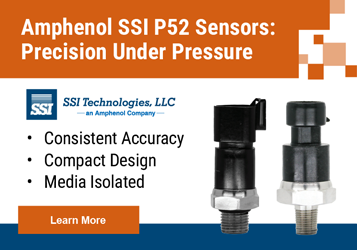
A pressure sensor measures pressure, typically of gases or liquids, but can also be used for a variety of functions such as calculating fluid and gas flow, speed, fluid level, and altitude. Also called pressure transducers, transmitters, or meters, pressure sensors are all devices that sense pressure and convert it into an electric signal based on the pressure applied.
Pressure sensors are used for control and monitoring in thousands of everyday applications, and can vary drastically in technology, design, performance, application suitability, and cost. Pressure sensor series will typically offer analog and digital output signals as well.
With so many configurations and pressure types available, it is important to work with a distributor such as TTI, which carries multiple brands to get the best product based on specific needs.
Smart Factory / Conveyor System
Optical
A photoelectric sensor, or photoeye, is a device used to detect the distance, absence, or presence of an object by using a light transmitter—often infrared—and a photoelectric receiver. They are used extensively in industrial manufacturing. There are three functional types: opposed or through-beam, which detects an object when it breaks the beam of light between two sensors; retroreflective, which detects an object when it breaks the beam of light between a sensor and mirror; and proximity sensors, which detect an object using electromagnetic fields.
Remote photoelectric sensors are ideal for challenging situations such as sensing over long distances or in hard-to-reach places as they contain only the optical components of a sensor, while the circuitry is located elsewhere. When space is restricted or the environment too hostile even for remote sensors, fiber optics may be used.
Optical sensors come in many different packages. A self-contained photoelectric sensor for factory automation contains optics and electronics that require a power source. This sensor performs its own modulation, demodulations, amplification, and output switching, while TTI also carries optical sensors such as ambient light, RGB, and a range of photointerruptors.
All Industrial, Indoor Growing
Temperature & Humidity
Thermal sensors range from bare thermocouples and resistive temperature devices (RTDs) to more sophisticated infrared non-contact sensors that can directly, consistently, and accurately measure a material’s temperature. In many systems, temperature control is fundamental. There are a number of passive and active temperature sensors that can be used to measure system temperature and provide feedback to the system controller to make temperature regulation decisions.
The type of temperature-sensing technology used in an application depends on the temperature range that needs to be detected. For example, a thermistor is used for temperatures from -100 to 500 degrees Celsius; a thermocouple best detects from -250 to 2,500 degrees; RTD is used for temperatures of -250 to 1,000 degrees; integrated circuit or digital sensors can detect from -20 to 150 degrees; and thermopile sensors are best for -55 to 200 degrees. Many new, digital or IC packages include humidity or pressure outputs as well.
Server Tower
Force & Flow
Force and flow sensors are high-sensitivity, high-accuracy sensors that detect minuscule particles and the slightest air or liquid flow. These sensors can be used to detect leaks in gas lines, clogs in an air filter, or the change in air quality. Flow sensors are often used in tankless water heaters to detect and measure the rate of water flow to help both conserve water while maintaining water pressure.
Force and flow sensors often require high performance and unique packages. Force sensors, including load cells, can come in a variety of packages and housings, specific to the environment and application. Due to unique factors such as pressure in each system and fluid volume, custom sensor designs are often required to ensure proper fit and functionality. TTI’s offering of air and gas flow sensors are extremely precise.
Transportation
Sensors serve as the crucial communication component between vehicle and operator, ensuring that vehicle functionality is performing as intended—as well as alerting and diagnosing when something isn’t right. Critical components of a vehicle, such as automated transmissions, engines, clutches, and brakes, are monitored by sensors for performance and safety purposes, ensuring a secure and enjoyable travel experience. Today, vehicle sensors have expanded beyond monitoring baseline operations — they increasingly contribute to passenger comfort, emissions reduction, and power train improvement. Sensors in vehicles must be able to perform in harsh environments, with the ability to endure temperature, vibration, and shock stressors. And as vehicles increasingly embrace automated components, sensors are crucial for collecting and communicating data for safe handling on the road.
Industry 4.0
Industrial revolutions have signaled growth in manufacturing technologies over time, from mechanization to mass production to computers and automation. The emerging fourth industrial revolution is characterized by a combination of cyber and physical systems, fueled by breakthroughs in artificial intelligence, robotics, and similar technologies. Sensors have been a key component to this new wave of manufacturing, allowing for the automated monitoring of operations, equipment, and systems. Sensors can help improve predictive maintenance, asset monitoring, and process automation. And when it comes to factory-wide automation, valve and equipment data collection, diagnostics, and alerts through sensors are imperative to keeping operations in sync. Used in such environments, sensors must also be able to communicate seamlessly with each other and appropriate endpoints to ensure systemwide coordination.
IoT
Smart, internet-connected devices range from consumer-level speakers and doorbells to enterprise-wide data collection, buildings, and response systems, and sensors are at the heart of them all. As the IoT industry continues to expand at a rapid rate — some $267 billion is expected to be spent on IoT by 2020, according to The Boston Consulting Group — sensors must continue to evolve. In order to work with the wide array of IoT devices, sensors must be able to adapt to offer multiple outputs, low-current consumption, and flexible, miniaturized packaging options. And Bluetooth and other wireless solutions are increasingly being paired with sensors to offer even more connectivity within the IoT environment.
Medical
A variety of sensors are used throughout the medical world, whether it’s to regulate and operate medical systems and devices or to monitor an individual. Sensors used for medical purposes are held to high standards and must provide unassailable accuracy and repeatability while meeting exacting specifications, including ISO 13485 certification and FDA registration. Medical equipment relies on sensors to control activity — such as using pressure sensors to place a patient under anesthesia—as well as accurately provide data to help diagnose and conduct treatment.
Specific sensors, such as air bubble detectors and biomedical sensors, are used primarily for medical purposes. However, sensors with broader capabilities are increasingly being paired with analytic technologies to build “smart” healthcare facilities. For example, infrared sensors can be used to monitor a patient’s activity — such as whether they are in bed or walking about the room — while respecting privacy and abiding by healthcare privacy laws.

Featured Suppliers