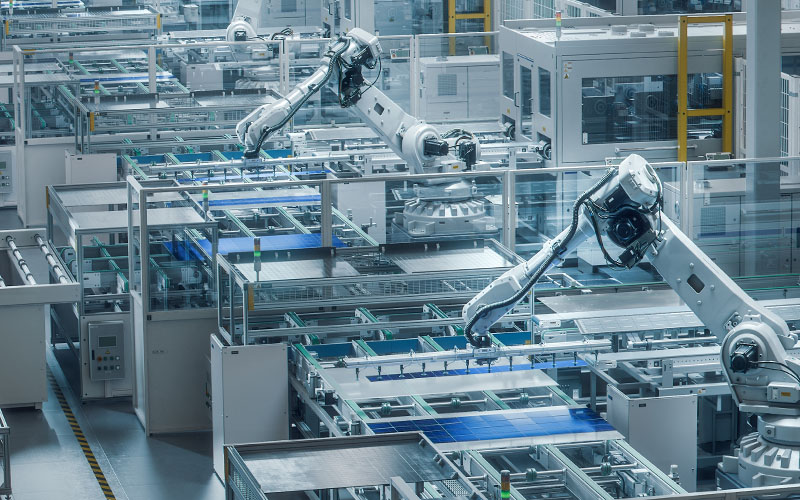
Smart factories are often described as data-driven, autonomous and self-optimizing. In practice, they are something else entirely: loud, dynamic and constantly changing environments filled with machines, people and processes all competing for attention. For engineers designing these systems, the challenge is not generating data, rather it’s determining which data can be trusted.
This is where sensor fusion has moved from a helpful concept to a foundational design requirement. In large industrial environments, no single sensor can provide enough context on its own. Accuracy improves when multiple sensing modalities work together, validating and enriching one another over time. Done correctly, sensor fusion reduces false positives, improves reliability and enables the predictive models that modern factories increasingly rely on. Done poorly, it creates noise, complexity and unreliable insight.
Why Single Sensors Fall Short at Scale
Factories have always been complex, but today’s facilities operate at a scale and speed that leave little room for ambiguity. Automated production lines, collaborative robots, autonomous material handling and condition-based maintenance systems all depend on accurate, real-time visibility into what is happening on the floor. Traditional sensing approaches — relying on a single temperature, pressure or vibration sensor — often struggle in these conditions. Environmental interference, mechanical wear and changing operating profiles introduce variability that can be difficult to interpret in isolation.
Sensor fusion addresses these limitations by combining inputs from multiple sensor types to create a more complete picture of system behavior. Common modality pairings include vibration and acoustic sensing for bearing diagnostics, thermal and current sensing for motor health, and pressure and flow sensing for pump efficiency analysis. When data from different modalities correlates, confidence increases. When it does not, engineers gain context rather than misleading alarms. One sensor may indicate that something has changed; multiple sensors help explain why.
This distinction becomes especially important in predictive maintenance applications. Rather than reacting to failures or relying on fixed service intervals, smart factories increasingly depend on systems that detect early signs of degradation and intervene before downtime occurs. Predictive maintenance relies on trend analysis rather than static thresholds, looking for subtle shifts over time that signal developing issues. Sensor fusion strengthens these models by improving accuracy, reducing false positives, and providing richer datasets that reveal cause-and-effect relationships instead of isolated events.
When More Data Becomes a Design Problem
At the same time, sensor fusion introduces new challenges. As more sensors are added to improve visibility, data volumes increase, sampling rates vary and systems grow more complex. Without careful system-level planning, more data can actually make decision-making harder. Engineers are forced to confront practical questions early in the design process: how different sensor data streams should work together, which combinations provide meaningful insight and whether sensors are physically placed to detect early anomalies or only obvious failures.
Placement is as critical as selection. A vibration sensor mounted too far from a bearing may miss early warning signs. A temperature sensor exposed to ambient airflow may mask localized heating. Sensor fusion cannot compensate for poor fundamentals and predictive models cannot correct for data that was never accurate to begin with.
These realities lead to two challenges that increasingly define the success or failure of sensor fusion in smart factories: protecting sensor data and maintaining its integrity over time.
Protecting the Data That Defines the Factory
As factories become more connected, sensor data takes on new value. Beyond basic condition monitoring, it can reveal production rates, utilization patterns, equipment health and proprietary process behavior. As this data moves across networks and into centralized platforms, security becomes a core engineering concern rather than a downstream IT problem. Decisions about sensor interfaces, communication protocols and system architecture all influence how data is protected throughout its lifecycle.
Secure transmission, access control and system resilience are no longer optional considerations. They shape design decisions alongside performance, power and cost, and they become increasingly important as smart factories scale and integrate with broader enterprise systems.
Another often overlooked aspect of system security and reliability is component authenticity. Sensors sit at the front edge of the data stream, and counterfeit or unverified components can introduce hidden points of failure that compromise both data integrity and system trust. Working with a partner that deals exclusively in fully authorized components, such as TTI, helps ensure sensors are 100 percent genuine and traceable back to the original manufacturer. This reduces the risk of counterfeit parts entering the system and protects predictive maintenance models from being fed unreliable or inconsistent data from the very start.
Data Integrity Over Time Matters More Than Ever
Even the most secure system, however, is only as useful as the data it protects. Predictive maintenance algorithms are fundamentally dependent on data quality and maintaining that quality over time is one of the most underestimated challenges in smart factory design. Sensors drift. Environmental conditions change. Mechanical systems age. Without thoughtful calibration strategies, long-term trends become difficult to interpret and models can degrade quietly.
Routine calibration strategies may include periodic baseline resets, seasonal compensation curves, sensor redundancy cross-checks and adaptive recalibration triggered by confidence drops in data thresholds. These approaches help ensure that fused sensor data remains stable and comparable over time, preserving the integrity of predictive models as operating conditions evolve.
This is particularly problematic in predictive applications, where confidence in the system is critical. Algorithms trained on inaccurate or inconsistent data can produce conclusions that appear precise but are fundamentally flawed. In many cases, predictive maintenance does not fail because the model is wrong — it fails because the underlying data has lost its integrity. Engineers must account for sensor aging, environmental effects and consistency across sensing modalities if fused data is expected to remain meaningful over years of operation.
Designing Sensor Fusion for the Long Term
Smart factories are not static installations. Production lines evolve, equipment is upgraded and operating conditions shift. Sensor fusion strategies must be designed with this reality in mind. Successful systems balance ambition with discipline, using multiple sensors where they add real value and prioritizing data quality over sheer volume. Security and calibration are treated as ongoing design considerations, not one-time checkboxes.
For engineers, this requires a holistic approach to sensing that considers everything from placement and modality selection to data handling and long-term stability. Sensor fusion is not simply about combining inputs; it is about building confidence in the decisions those inputs enable. As factories continue to adopt autonomous functions and predictive strategies, the role of sensors will only grow more critical. In complex, noisy environments, clarity does not come from more data alone, but from better data working together.
Follow TTI, Inc. on LinkedIn for more news and market insights.
Statements of fact and opinions expressed in posts by contributors are the responsibility of the authors alone and do not imply an opinion of the officers or the representatives of TTI, Inc. or the TTI Family of Specialists.
Follow TTI, Inc. - Europe on LinkedIn for more news and market insights.
Statements of fact and opinions expressed in posts by contributors are the responsibility of the authors alone and do not imply an opinion of the officers or the representatives of TTI, Inc. or the TTI Family of Specialists.