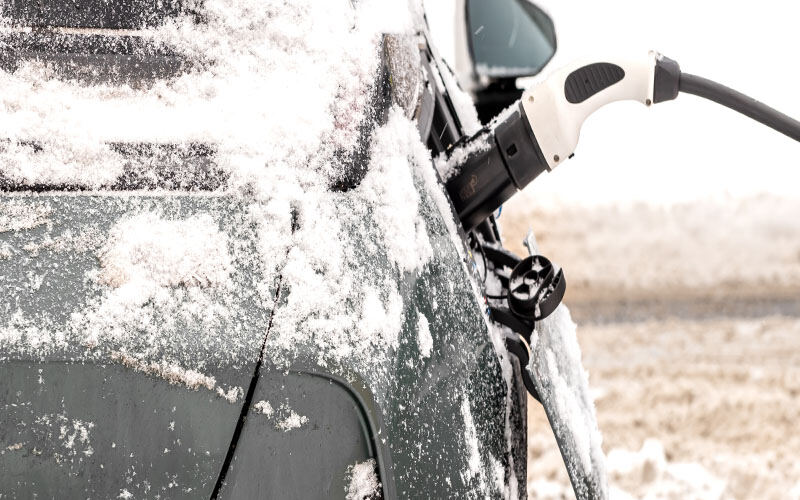
The growth of EV adoption is a clear and obvious trend. But In order for EV proliferation to occur at the predicted levels, technological advances are needed. For example, cold temperatures increase the internal resistance of a battery. This can lower the battery’s capacity, meaning it can’t release as much energy or retain a charge as well. As a result, in severe winters, an electric vehicle can lose a significant percentage of its range, contributing to winter "range anxiety" in northern regions.
How Do Different Types of Batteries Hold Up in Cold Weather?
As traditional energy storage solutions, lead-acid batteries exhibit notable limitations in cold climates, Lithium batteries have much better performance at colder temperatures. But here, too, low temperatures slow down the chemical reactions inside EV batteries, which causes a temporary loss of driving range and reduced charging speeds because fast chargers work much slower in the winter. Lithium ions move slowly when it is cold, which raises internal resistance and drops battery voltage.
At lower temperatures, the electrolyte becomes thicker, significantly reducing the diffusion rate of lithium ions. The slower the ions reach the electrode surface, the more the entire electrochemical reaction slows down. At low temperatures, the kinetics of lithium-ion insertion and extraction in cathode materials (such as NMC ternary lithium or LFP lithium iron phosphate) and anode materials (usually graphite) slow down significantly. Cold air also creates more wind resistance, and winter tires or snow creates more rolling resistance.
AAA conducted a study that showed lithium batteries (LiFePO4, not lithium-ion batteries) fare better in wintry conditions than other battery types, but they still need protection from harsh environments. The AAA automotive engineering team, in partnership with the Automobile Club of Southern California’s Automotive Research Center, evaluated the powertrains of three EVs and three hybrids. Testing was conducted with the HVAC (heating, ventilation and air conditioning) set at 72 degrees in the vehicles and the temperatures in the laboratory test cell at 20°F, 75°F and 95°F. The cold weather results:
- Hybrids lost 22.8% in fuel economy.
- EVs demonstrated a 35.6% drop in MPG and a 39.0% decrease in calculated driving range.
- Hybrids showed an increase in fuel cost of $28.44 per 1,000 miles in cold temperatures (20°F)
- EVs experienced an increase in operating costs of $32.11 per 1,000 miles when charged at home electricity rates and $76.93 per 1,000 miles when using public charging.
For electric vehicles, AAA's 2023 winter test report shows that in an environment of -7°C, the average driving range (without heating) decreases by about 12%. With heating on, the decrease rises to about 41%. This indicates that while battery capacity loss is partly due to the battery itself, additional loads such as heating, defrosting and cabin heating are the main reasons for the significant reduction in driving range in winter.
What Can Be Done?
By optimizing electrode materials, upgrading electrolyte formulations, applying ceramic separator technology and enhancing conductive additives, researchers have significantly improved battery temperature adaptability, cycle life and output performance.
Areas of research include:
- Surface coating and doping working together to improve the thermal stability of materials
- Artificial or natural graphite, treated with surface modification and nanomaterial techniques, to enhance lithium-ion insertion and extraction performance at low temperatures, and carbon nanotubes and graphene are used as conductive agents to reduce internal resistance and improve conductivity at low temperatures
- Using low-viscosity solvents and high-conductivity lithium salts to reduce impedance at low temperatures
- Using film-forming additives to reduce impedance on the electrode surface, improving performance in low-temperature charging and discharging
- Using high-porosity separators to enhance electrolyte permeability, aiding ion transport in low temperatures
Other Solutions
Addionics’s (Tel Aviv, Israel) battery architecture for low-temperature performance is designed to increase battery operations and charging capabilities at low temperatures. Addionics’ Smart 3D Porous Current Collectors change the internal transport architecture of the battery. Electrolyte and lithium ions move directly through the current collector plane instead of just traveling around it. Shorter transport paths spread the electrochemical reaction across a larger volume of the electrode. The design replaces standard flat metal foils inside the battery.
The porous structure is said to allow electrolyte and lithium ions to move through the current collector plane, creating additional access pathways throughout the electrode. This reduces effective transport distances, improves active-material accessibility and distributes electrochemical activity across a larger volume. No heating is needed. The architecture does not use external heaters. By improving how ions, electrons and electrochemical reactions are moving inside the cell, the technology enables batteries to retain more of their intended performance when temperatures decrease.
Researchers at Texas A&M University have developed a battery design that continues operating through the coldest conditions. The team, led by Dr. Jodie Lutkenhaus, professor of chemical engineering and Associate Dean for Research in the College of Engineering, published findings on a polymer-based battery in the Journal of Materials Chemistry. They built a battery said to be capable of maintaining functionality in temperatures as low as -40°C. In the battery, polymer electrodes are combined with a diglyme‑based low‑temperature electrolyte that uses bis(2-methoxyethyl) ether as a low-freezing-point solvent combined with salts to maintain high ionic conductivity and performance in a freezing environment.
The researchers’ organic dual‑ion battery uses redox‑active polymers – polymers containing groups that can be reversibly reduced or oxidized. In other words, these polymers have the ability to change their electrochemical properties via losing electrons (oxidation) or gaining electrons (reduction) – instead of the inorganic electrode materials found in most commercial batteries. Simply put, they replaced the liquid electrolyte that freezes with a different electrolyte that does not. They also substituted hard inorganic materials that are sluggish at low temperatures with soft polymer materials that are a bit faster.
Follow TTI, Inc. on LinkedIn for more news and market insights.
Statements of fact and opinions expressed in posts by contributors are the responsibility of the authors alone and do not imply an opinion of the officers or the representatives of TTI, Inc. or the TTI Family of Specialists.
Follow TTI, Inc. - Europe on LinkedIn for more news and market insights.
Statements of fact and opinions expressed in posts by contributors are the responsibility of the authors alone and do not imply an opinion of the officers or the representatives of TTI, Inc. or the TTI Family of Specialists.