Halogen-Free in Washington State
Long ago, I wrote about safer products in Washington (state). What was just a thought then became a law with real consequences some years later. And now the consequences of what I warned about, namely products with a flame-retarded plastic enclosure that includes an organohalogen flame retardant (OFR), have come to roost.
The Safer Products Restrictions and Reporting Rule was adopted in 2023 and implements the Safer Products for Washington (SPWA) program. While Washington is a relatively small market, like Minnesota and PFAS, it is flexing its regulatory muscles to stop the use of additive OFRs in the enclosures of electronic products.
While OFRs were restricted in televisions and displays in 2025, the restriction kicks in for other electronics with plastic enclosures containing OFRs as early as January 1, 2027 (for manufacturers with global sales equal to or exceeding $1 billion in 2022; the requirement comes into force on January 1, 2028, for manufacturers with global sales under $1 billion in 2022).
Note too that “consumer products” is defined to mean “any item, including any component parts and packaging, sold for residential or commercial use.” The scope is electric and electronic products with plastic external enclosures, intended for indoor use that are powered by 120VAC outlets up to 20A or a battery.
So, review the law and its requirements. It’s already too late to make changes to products due to be regulated in a couple months and, in many cases, for those due to be regulated in 2028.
Why am I bothering to discuss it here? The key issue here is the continued drive to regulate at the state level in a manner that is entirely unharmonized. That, of course, is the state’s right! The fundamental enabler of this is the lack of federal engagement and regulation. With the current administration’s misguided thought process that deregulation is always going to be better for industry, and the previous administration’s inability to regulate appropriately due to years of insufficient funding of the EPA and a Congress that had no interest in changing that, we’re unfortunately doomed to more of this. And we see it coming with more states stepping up and regulating PFAS, packaging, batteries and who-knows-what-else in inconsistent manners.
So, write to your member of Congress. Help them understand your challenges and how they might help to fix the growing mess of inconsistent environmental regulations manufacturers in the U.S., as well as foreign sellers serving the U.S. as a market, are already dealing with. The U.S. doesn’t need to be the EU, but this must be addressed sooner rather than later.
The Patchwork of Right to Repair Laws
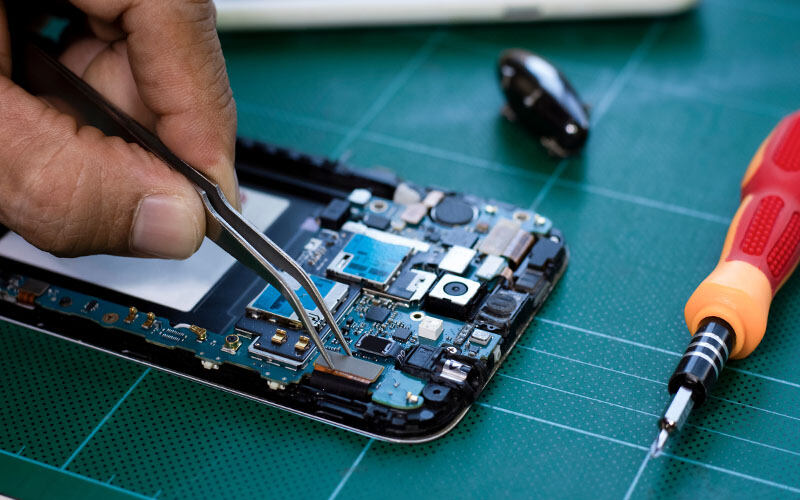
In addition to the European Union, a growing number of U.S. states are implementing right to repair laws. The intent of these regulations is to extend the use life of electronic products by guaranteeing that products are repairable, spare and replacement parts are available, firmware updates are available and independent repair facilities are supported. This impacts how products are structured and designed, since repairability – and the degree of modularity required to partition a design into sections that can be replaced as needed – is designed in.
The EU’s Right to Repair Directive (EU) 2024/1799 became applicable across all EU member states on July 31, 2026, establishing direct consumer rights and manufacturer obligations that favor repairing goods over replacing them. The list of products in scope of the repairability requirements in Annex II includes:
| Products | Regulation |
|---|---|
| Household washing machines and household washer-dryers | Commission Regulation (EU) 2019/2023 |
| Household dishwashers | Commission Regulation (EU) 2019/2022 |
| Refrigerating appliances | Commission Regulation (EU) 2019/2019 |
| Electronic displays | Commission Regulation (EU) 2019/2021 |
| Welding equipment | Commission Regulation (EU) 2019/1784 |
| Vacuum cleaners | Commission Regulation (EU) No 666/2013 |
| Servers and data storage products | Commission Regulation (EU) 2019/424 |
| Mobile phones, cordless phones and slate tablets | Commission Regulation (EU) 2023/1670 |
| Household tumble dryers | Commission Regulation (EU) 2023/2533 |
| Goods incorporating light means of transport batteries | Regulation (EU) 2023/1542 |
| Domestic local space heaters | Commission Regulation (EU) 2024/1103 |
While the repairability requirements are defined in the product-specific EcoDesign, implementing acts listed above, the directive sets a common set of requirements across these individual product categories. The baseline obligations, which now become effective once the initial warranty period is over, include (per Articles 5 and 6):
- Repair for free or “for a reasonable price”
- “It shall be carried out within a reasonable period of time from the moment the manufacturer has” the item
- “The manufacturer may provide the consumer with the loan of a replacement good free of charge or for a reasonable fee for the duration of the repair”
- “In cases where the repair is impossible, the manufacturer may offer the consumer a refurbished good”
- Repair may be sub-contracted by the obligated downstream supply chain owner if the manufacturer is not based in the EU
- Spare parts and tools shall be offered at a “reasonable price” that does not deter repair
- Typical pricing must be made publicly available
- No prevention of use of compatible spare parts
- Manufacturers must make information on their repair services easily accessible and in a clear and comprehensible manner
The European Commission will develop an online platform for repair to enable consumers to find repairers and, where applicable, sellers of refurbished goods, purchasers of defective goods for refurbishment or community-led repair initiatives.
U.S. states with right to repair laws include:
- New York statute: GBL §399-nn; attorney general statement: AG consumer alert (Jan 2024)
- Minnesota statute: Minn. Stat. §325E.72; attorney general landing page: The Right to Repair in Minnesota
- California statute: Pub. Res. Code §42488 (Justia copy)
- Oregon statute: ORS Chapter 646A (sections 646A.850–.859)
- Colorado statute: C.R.S. §6-1-1503 (Justia copy)
- Washington statute: Chapter 19.415 RCW
- Connecticut statute: Chapter 735b, §42-110x
- Texas enrolled bill: HB 2963
Note that, in typical manner, the states’ laws are not harmonized in terms of scope, requirements or date of entry into force. Unfortunately, this means that review of each one is required. And other states are working to pass such bills as well.
So, while this may not yet include products that you design and manufacture, the writing is on the proverbial wall. As an electronics engineer, I’ve often had a difficult, if not impossible, time to disassemble and replace the problem component in a given product. For instance, I had a subwoofer that was wonderful, but after about 3 years of use it failed, well past the 1-year warranty period. The product was not in any way designed for disassembly and repair (or even, it seems, for a reasonable use life). I effectively had to destroy the enclosure to get to the failed amplifier for analysis, thereby rendering repair impossible. I ultimately replaced it with a different brand’s product. This has never been acceptable to consumers and, finally, is no longer acceptable to governments.
The biggest challenge manufacturers – particularly of consumer products – face is the small and often negative cost differential between repairing a product and replacing it with a newer version. While redesigning for repairability will reduce the cost of repair, the effect of a longer product use phase may effectively be cannibalization of the product line. So, manufacturers should also consider upgradeability to improve performance – and improve the potential for an upsell – as part of the repair offering. Forward-thinking manufacturers are designing products this way already.
Visit DCA at www.DesignChainAssociates.com or email the author with any questions or comments on this post.
Statements of fact and opinions expressed in posts by contributors are the responsibility of the authors alone and do not imply an opinion of the officers or the representatives of TTI, Inc. or the TTI Family of Companies.
Follow TTI, Inc. on LinkedIn for more news and market insights.
Statements of fact and opinions expressed in posts by contributors are the responsibility of the authors alone and do not imply an opinion of the officers or the representatives of TTI, Inc. or the TTI Family of Specialists.
Follow TTI, Inc. - Europe on LinkedIn for more news and market insights.
Statements of fact and opinions expressed in posts by contributors are the responsibility of the authors alone and do not imply an opinion of the officers or the representatives of TTI, Inc. or the TTI Family of Specialists.