
For years, factories have been successfully built around the ISA-95 model. But Industry 5.0 introduces new requirements: digital twins, edge intelligence, cross-functional visibility and, increasingly, agentic AI systems that depend on shared operational context.
These demands are exposing a missing layer in many IIoT architectures – the ability to make data universally available, contextualized and actionable in real time.
Smart factories today generate more operational data than ever before. Yet, industry studies show a striking share of operationally critical manufacturing data remains locked in silos, invisible to the systems designed to act on it. The bottleneck is rarely a hardware problem or a connectivity gap. It is an architectural one.
That is where the Unified Namespace (UNS) enters the conversation.
ISA-95 Got Manufacturing Right – But Factories Have Changed
The ISA-95 functional model gave industrial automation something it badly needed: a principled framework for organizing manufacturing systems into a coherent hierarchy, from field devices and PLCs at the base through SCADA, MES and ERP at the enterprise level. That structure brought discipline to factory floor integration and remains a sound design reference. The principle of keeping machine controls isolated from broader network exposure, for instance, is as relevant today as it was when ISA-95 was first adopted.
The challenge is that modern factories increasingly require the same operational data to feed many consumers simultaneously: dashboards, AI applications, quality analytics, maintenance platforms, digital twins and executive decision systems.
Under traditional integration approaches, each additional consumer often creates another interface.
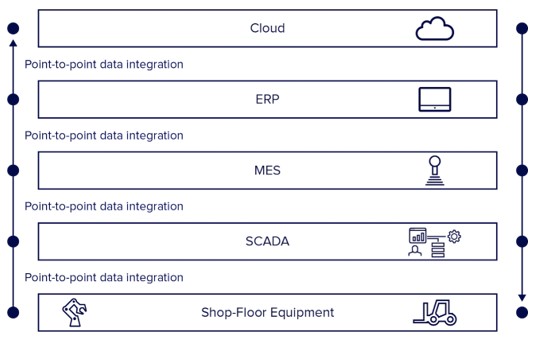
Source: IIoT World. The ISA-95 Hierarchy
Machine → SCADA → Historian → MES → Cloud → Analytics.
Multiply that across sites, systems and applications, and the result becomes integration sprawl.
Manufacturers are discovering that adding intelligence no longer scales if every new use case requires another custom connection.
What a Unified Namespace Is
Unified Namespace reframes the problem entirely. Rather than routing data through a chain of intermediaries, it establishes a central data hub – a single, semantically organized layer where every system, device and application in the enterprise publishes and consumes information.
The ISA-95 hierarchy is retained as the organizing principle: data is structured by enterprise, site, area, line and cell. But instead of flowing through that hierarchy sequentially, data is published once and made immediately available to any authorized consumer – whether that is an MES, an AI inference engine, a digital twin or an edge node on the factory floor.
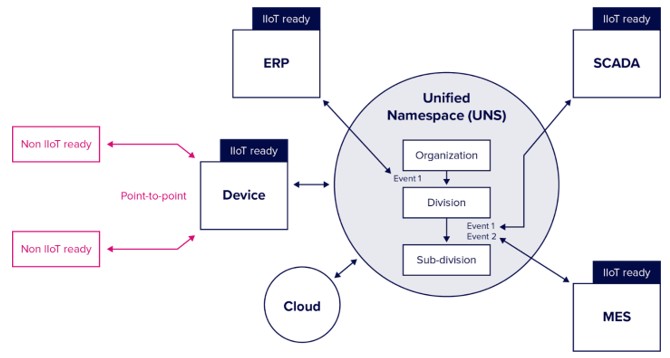
Source: IIoT World. The Unified Namespace Architecture
The shift in integration complexity is significant. Where ISA-95 required N×(N-1)/2 connections, UNS reduces every system to a single connection to the central broker – regardless of how many other systems exist on the network. Adding a new AI platform, analytics tool or edge device means connecting once, not reconfiguring everything else.
Protocols like MQTT with Sparkplug B, which support pub/sub architecture, can serve as the lightweight messaging backbone. However, UNS is a design pattern not limited to any specific protocol.
For brownfield environments, protocol converters and IIoT gateways can bring legacy PLCs and older controllers into the namespace without disrupting live production. The transition to UNS is incremental by design.
Why Unified Namespace Matters for Industry 5.0
In a previous MarketEYE article, we explored how manufacturing is shifting toward human-centric, resilient and intelligent operations. Those goals depend on something often overlooked: shared operational context.
Digital twins require synchronized state across assets and systems.
Agentic AI systems require access to current operating conditions before recommending actions.
Edge intelligence requires localized decision-making without losing enterprise visibility.
Without a unified operational data layer, these systems become isolated islands of intelligence.
Consider predictive maintenance. Traditionally, vibration data might remain inside a historian. With a UNS model, the same signal can simultaneously feed maintenance applications, energy optimization tools, operator dashboards and AI orchestration layers.
The factory increasingly behaves less like a collection of machines and more like a distributed software system.
Implications to System Design
In smart factories, connectivity is no longer the only coefficient. The new design objective includes data mobility while preserving context.
That creates several implications.
First, event-driven design becomes more valuable than request-driven architectures. Systems publish operational changes once rather than serving repeated data requests.
Second, information modeling becomes a first-class engineering discipline. Naming conventions, asset hierarchy, metadata and governance increasingly determine long-term scalability.
Third, edge and cloud responsibilities become clearer. Local systems maintain deterministic control while enterprise layers consume context and optimize globally.
Finally, security evolves alongside architecture. OT segmentation remains essential, but contextualized data sharing enables IT/OT convergence without collapsing boundaries.
The result is an architecture that scales more gracefully as factories add AI, automation and analytics.
The Physical Layer Still Determines Success
Unified Namespace is often discussed as a software pattern. But its success begins with hardware. Data quality originates at sensors.
Reliability depends on connectors, networking, power integrity and edge infrastructure. Interoperability depends on systems that remain maintainable across long industrial lifecycles. This is where the component ecosystem becomes strategic.
No digital thread becomes intelligent if the physical layer cannot sustain it.
Suppliers such as TTI Inc. help enable industrial data architectures by supporting the physical infrastructure behind IIoT deployments – from sensing and connectivity to reliable power and long-life component availability.
Designing Context-Aware Factories
The Unified Namespace architecture extends the ISA-95 foundation to meet the demands of Industry 5.0 – real-time visibility, digital twins, agentic AI and distributed intelligence.
The factories that create an advantage over the next decade may not be those that collect the most data, but rather those that organize, contextualize and activate it fastest.
And, increasingly, that begins with treating data architecture as seriously as system architecture.
Sravani Bhattacharjee has worked as a tech leader at Cisco, Honeywell and other companies, where she delivered many successful innovations to the market. As the principal of Irecamedia, she collaborates with Industrial IoT innovators to create compelling vision, strategy and content that drives awareness and business decisions.
Follow TTI, Inc. on LinkedIn for more news and market insights.
Statements of fact and opinions expressed in posts by contributors are the responsibility of the authors alone and do not imply an opinion of the officers or the representatives of TTI, Inc. or the TTI Family of Specialists.
Follow TTI, Inc. - Europe on LinkedIn for more news and market insights.
Statements of fact and opinions expressed in posts by contributors are the responsibility of the authors alone and do not imply an opinion of the officers or the representatives of TTI, Inc. or the TTI Family of Specialists.