
The proliferation of IoT devices across industries, cities, homes and enterprises accelerated the promise of a connected, autonomous ecosystem. But just like a double-edged sword, it comes at the cost of new risks. Since IoT applications converge the cyber and physical worlds, IoT cyberattacks directly affect environmental and public safety.
As a demonstration, in July 2015, two security experts remotely hacked a Jeep by connecting to the car’s multimedia system. Using that connection, they could send messages over the car’s CAN bus and gain control over its steering, brakes and accelerator, with the potential of fatal consequences. Mass distributed denial-of-service (DDoS) attacks using IoT botnets, data theft, network hacking and privacy invasions are other growing risks.
A SHIFT TOWARD HARDWARE SECURITY
IoT electronics with low memory and CPU footprints limit the scope for software-based security. So far, hardware security has been limited to speeding up software security like encryption engines. However, there’s an increasing shift in designing hardware security to protect the metal itself since an IoT device with compromised firmware or damaged hardware cannot be relied on for secure data transmissions.
In an experiment, security experts demonstrated that they could change the ID of a smart energy meter due to the lack of proper cryptographic protection. The compromised smart meter can "represent" itself as any other smart meter. Thus, two smart meters could share the same ID but with different power consumption values, facilitating potential energy theft.
The chart below summarizes the typical hardware and firmware vulnerabilities.
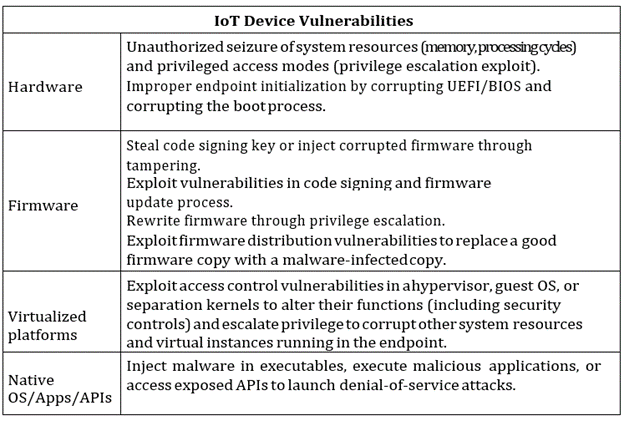
Chart 1: IoT Device Vulnerabilities (Source: Practical Industrial Internet of Things, ISBN 978-1-78883-268-7)
ESTABLISHING SECURITY IN HARDWARE
Although hardware-based security involves the complexity of managing firmware and crypto library updates, it outperforms the software-based alternative on many counts. For one, hardware-based security lowers power consumption, a significant consideration in low-power environments. The table below compares other factors.
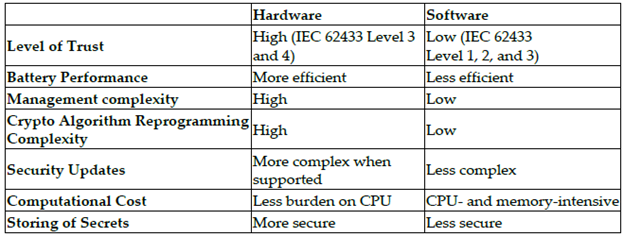
Chart 2: Comparison of Hardware and Software Device Security (Source: Practical Industrial Internet of Things, ISBN 978-1-78883-268-7)
COMPONENTS FOR HARDWARE SECURITY DESIGN
Field programmable gate arrays (FPGAs), crypto-accelerators, hardware security modules (HSM), trusted platform modules (TPMs) and hardware-based trusted execution environments (TEEs) are some examples of hardware security components. Integrating these components into the CPU board itself improves upgradeability and device performance.
An FPGA can be reprogrammed. It supports firmware updates and may include a CPU coprocessor to perform housekeeping operations for the security functions.
Crypto accelerator modules embed cryptographic functions in hardware that speed up security while improving its robustness. A hacker may perform a code injection attack on a software-based AES where the encrypted results are easily reversible. However, the AES implemented in hardware is immutable and cannot be attacked.
System designers can use HSMs to isolate security functions in the same physical device platform.
TPM (defined in ISO and TCG standards) chips are embedded in the motherboard and provide strong tamper resistance by using hardware random number generators (RNGs) for cryptographic key generation and storage, strong authentication, boot integrity protection, etc.
Root of trust
In IoT devices, the root of trust (RoT) are components, or computing engines, constituting a set of unconditionally trusted functions that always behave as expected because their misbehavior cannot be detected (NIST 800-150). RoT represents a device’s highest level of trust, and a compromise on the RoT compromises trust for the entire system.
RoTs implemented in hardware outperform their software equivalent due to their highly reliable trust performance in a significantly higher percentage of attack scenarios. Although software ROTs are less expensive, there is a trend to implement the RoT in hardware like in a TPM, irrespective of whether the device is an industrial PC with more memory or a sensor with a smaller memory footprint.
Securing secrets or sealing
Passwords, shared secrets and data encryption keys are typical examples of secrets stored in a device. Unauthorized disclosure of these keys compromises the device and, subsequently, the broader ecosystem of devices, facilitating attacks like DDOS.
Secrets stored in the TPM are much more resilient to loss through physical, network or software interfaces. However, the TPM crypto engine’s limited power in scaled environments may lower signing throughput in IoT gateways, routers and servers. A possible solution is to hold the keys at rest in the TPM's encrypted storage and release them to access platform software or a high-throughput crypto engine on a need basis. This mechanism, called sealing, is where keys (or other secrets) are stored in the device's filesystem in an encrypted file that can only be decrypted with keys released from the TPM when a predefined set of criteria is met.
Secure boot
Attackers can inject code into firmware updates or compromise the update process, gaining backdoor access and potentially infecting the entire device. Once compromised, recovery can be highly challenging.
Most attackers attempt to inject code into the core boot code or applications that load subsequently. System designers can secure firmware updates using signature verification and crypto measurements. Verified boot is a mechanism that halts the entire boot process after detecting unauthorized firmware. Measured boot is another mechanism that cryptographically detects malicious code in the firmware and can detect firmware vulnerabilities and obsolete versions to trigger a firmware update.
THE ROAD AHEAD
Our increasing dependency on connected devices underscores the importance of IoT security. The cost and complexity associated with hardware security are never too big of a trade-off, considering the trustworthiness it adds to IoT designs compared to software-based security. TTI is committed to enabling IoT designs that are resilient to modern threats by providing a wide array of highly reliable components to embed trust in IoT hardware.
Sravani Bhattacharjee has worked as a tech leader at Cisco, Honeywell and other companies where she delivered many successful innovations to the market. As the principal of Irecamedia, she collaborates with Industrial IoT innovators to create compelling vision, strategy and content that drives awareness and business decisions.
Follow TTI, Inc. on LinkedIn for more news and market insights.
Statements of fact and opinions expressed in posts by contributors are the responsibility of the authors alone and do not imply an opinion of the officers or the representatives of TTI, Inc. or the TTI Family of Specialists.
Follow TTI, Inc. - Europe on LinkedIn for more news and market insights.
Statements of fact and opinions expressed in posts by contributors are the responsibility of the authors alone and do not imply an opinion of the officers or the representatives of TTI, Inc. or the TTI Family of Specialists.