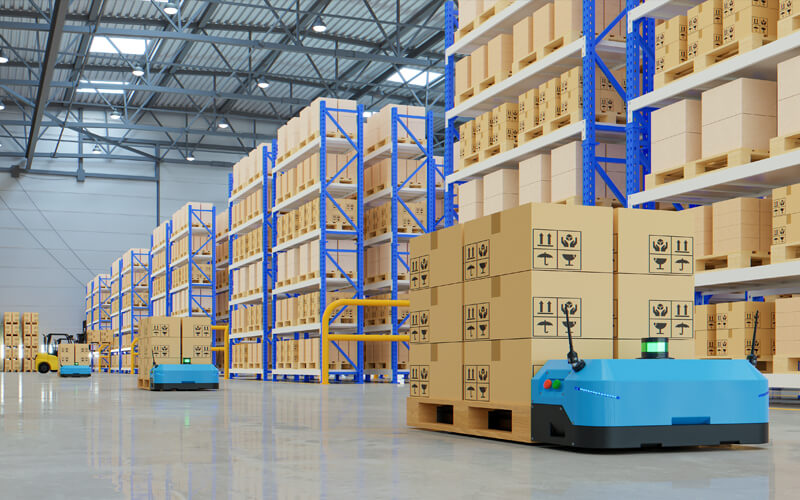
The meteoric rise in e-commerce since the start of the COVID-19 pandemic (global rates increased by nearly 25 percent in 2020 alone, according to research firm e-Marketer) has accelerated the need for warehouse automation. Global supply chain glitches in the wake of the pandemic have also placed warehouses in general under increased scrutiny. After all, time saved within the warehouse is money gained.
As a result, warehouse automation is a robust growth market with a compound global annual rate of 14.6 percent, according to Brandessence Market Research. Although moving to digitalization will take a significant upfront investment, organizations might find that the efficiencies gained are well worth the expense.
Industry offers various technologies to address warehouse challenges, and confusion abounds from the conflation of digital process automation with its physical equivalent. Warehouses can benefit from both kinds.
The Types of Automation
Digital automation runs primarily on software and helps automate or orchestrate workflows. Digital checklists of tasks and synchronization of tasks between workers all run because of such automation. Warehouse management software that carries out these processes can also integrate with inventory management software and enterprise resource planning (ERP) systems to create an optimized system that runs like a well-oiled machine.
On the other hand, physical automation in the warehouse addresses the actual movement of goods within the space. These systems increase efficiency by having goods flow so as to decrease worker movement. Such automation can range from the most basic techniques, such as the use of conveyor belts to transport goods, to advanced artificial intelligence (AI) models being deployed to create various efficiencies, including optimal layout patterns, on the warehouse floor.
“Under the Hood” of Warehouse Automation
Warehouse automation technologies that address aspects of the physical movement of goods fall into various buckets depending on the task they address – transport or sorting – in a variety of categories.
Autonomous mobile robots (AMRs) are arguably the best iteration of robots for the warehouse: they use GPS to chart their routes and can navigate around obstacles and people while doing the hard task of transporting heavy loads. These robots also may be used in sorting and packing, although their implementation is still in early stages while the task of varying pressure is being perfected according to the product being handled. An egg, for example, needs a very different kind of handling compared to a tennis ball.
Autonomous guided vehicles (AGVs) are a slightly more constrained version of AMRs as they follow only prescribed paths in a warehouse.
Automated sortation systems use barcodes, sensors and RFID tags to route products to different sections of the warehouse, saving operator time. Pick-to-light and put-to-light systems synchronize mobile barcode scanners to digital light displays so workers can be routed to the appropriate stations effectively and while keeping an eye on productivity.
The electronic components under the hood of these various warehouse automation technologies draw from the basics. Robots, for example, need power systems to drive them, microcontrollers and processors to act as their brains, and sensors and actuators to gather information and react to it.
Practically all the key drivers of warehouse automation projects will need electric drives, batteries, charging stations, motor controllers and more. Battery management systems for lithium-ion batteries are also becoming increasingly commonplace.
Automated warehouses do not function just by placing a few AMRs or AGVs on the floor. To work smoothly and in sync, these automation solutions need to communicate with each other and with centralized networks. Programmable logic controllers (PLCs) or embedded microcontrollers receive and process data and direct response through actuators or motors.
Local area networks (LANs) connect these information standalone units together and gateway nodes in turn merge LANs into a wide-area network (WAN). The enterprise receives data from the WAN and, if machine learning and advanced analytics are in place, can use it to fine-tune processes – even across entire portfolios of warehouses.
Suppliers and Distributors Are Here to Help
The degree of automation in a warehouse is not static and depends on layout, final objectives and existing legacy systems. System integrators will play a key role in making all the parts work together. They will especially have to integrate IT and operational technology (OT) together, which can be challenging.
An experienced, specialist electronic component distributor can recommend custom solutions that work with systems manufacturers already provide, so that the new devices and systems produced for warehouse automation sync well with what’s already deployed while meeting automation objectives. Component suppliers and distributors will also help provide knowledge so that the solutions you build now can be extensible and ready to interface with new technologies as they are developed.
The warehouse itself is a work in progress. As operations move closer to urban centers, micro-fulfillment warehouses will need a revised set of nimble technologies. Whichever directions these operations move in, system integrators and electronics components distributors will play a key role in tracking its evolution and implementing the latest warehouse technologies.
Follow TTI, Inc. on LinkedIn for more news and market insights.
Statements of fact and opinions expressed in posts by contributors are the responsibility of the authors alone and do not imply an opinion of the officers or the representatives of TTI, Inc. or the TTI Family of Specialists.