This is latest in a series of articles examining leading technology trends which have had a significant impact on the electronic connector industry:
2000 | 2010 | 2020 |
USB 1.0 @ 1.5Mb/s | USB 3.0 @ 5Gb/s | USB 4 @ up to 40Gb/s |
Blackberry | iPhone | Smartphones as an interface device |
3G cellular | 4G cellular | 5G cellular |
3.125Gb/s NRZ | 25Gb/s NRZ | 112Gb/s PAM4 |
Rise of data centers | Cloud computing | Edge / Fog computing |
Copper circuits | Increasing fiber options | Silicon photonics / expanded beam technology |
Many proprietary connectors | Licensed second-sourced connectors | Rise of open component / system standards |
PCIe 1.0 @ 2.5GT/s | PCIe 3.0 @ 8GT/s | PCIe 5.0 @ 32 GT/s |
10Gb Ethernet | 40/100Gb Ethernet | 200/400Gb Ethernet |
Multilayer enhanced FR4 backplanes | Multilayer high-performance laminate backplanes | Orthogonal midplane, cable backplanes, twinax cabling |
Chip feature size 90nm | Chip feature size 32nm | Chip feature size 5-10nm |
Antenna TV | Cable TV | Streaming TV |
Connectors that are designed and manufactured by a single source are considered “branded” and, if they are adopted by many users, can provide an excellent continuing stream of income. The Fuzz Button connector from Custom Interconnects and the CIN: APSE connector from Bel Fuse are examples of similar, but proprietary, compressive interfaces designed to provide connection between two parallel conductive surfaces.
Some of these proprietary interfaces have been associated with specific applications and become “cash cows” for their owners. A connector may be so unique and support such a very specific application that it may remain a proprietary interface forever. Connectors designed for use in nuclear reactors or that provide critical interconnect between stages of a missile require exceptional design and material choices, with production volumes insufficient to attract competitors.
Even today, some proprietary connectors continue to exist in high-volume markets, such as automotive, where manufacturers have chosen to tool unique connectors for specific applications, including diagnostic, video camera and radio interfaces.
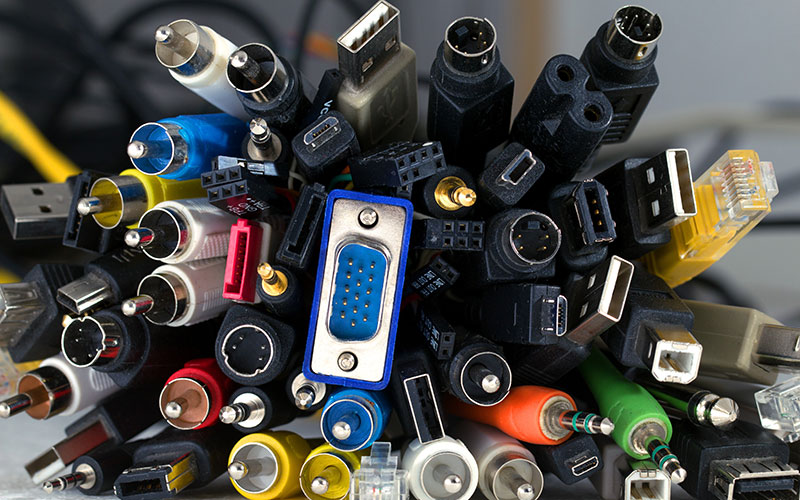
Connectors are often created to fill emerging applications. The Radio Corporation of America introduced the RCA phono plug in the 1940s as a low-cost interface for their expanding line of record players. It soon was adopted in a wide variety of audio applications and continues to be used today.
Some connectors evolve from their original applications to became de facto standard interfaces in entirely new high-volume markets. The 25-pin D-shell connector originally developed by ITT Canon for military aviation systems (MIL-DTL-24308) was commercialized and became a common interface in many low-cost commercial and consumer computing and gaming applications. The Centronics Micro Ribbon interface developed by Amphenol for use in telecom applications became a standard I/O on printers. And the RJ45 modular plug developed by Bell Labs for telephone applications in the 1970s later became the ubiquitous Ethernet interface.
Other examples of globally-standardized connectors include those certified by Deutsches Institut für Normung (DIN). DIN two-piece backplane and circular connectors have become commodity interfaces and are tooled by dozens of manufacturers, mostly in Asia.
Mobile Device Connector Standards
Fast forward to the proliferation of mobile phones. Various suppliers designed their charging ports with a unique connector which required the use of adapters to charge the many iterations.
Apple Computer has a reputation for designing proprietary connectors to maintain control of their attachments, as well as control of pricing. The Apple display connector was a proprietary modification of the standardized DVI interface and appeared on selected Apple equipment before it was phased out. The Apple 20-pin connector used and the newer 8-pin Lightning connector continue this marketing strategy.
Equipment manufacturers hate to be limited to a sole source for a critical component. A manufacturer of a branded interface can manipulate pricing while posing a supply threat if the manufacturer cannot support demand or decides to withdraw from the market. In order to address that concern, connector manufacturers may choose to offer a license to a competitive second source. The Apple Lightning connector, for example, is available for licensing to other suppliers at a per-connecter fee.
In some cases, only the physical dimensions of the interface are licensed, allowing the licensee the ability to offer a fully intermateable connector with enhancements such as footprint design, PCB attachment method or type of termination. The last 10+ years has seen a major increase in specifications that require all hardware be available for license at a fair and non-discriminatory fee (FRAND).
Flagship Connector Products
Large connector manufacturers have invested huge amounts of resources in the development of their flagship high-speed backplane connectors. Because the performance of the backplane is such a critical element of high-performance telecom and datacom equipment, use of a sole-sourced connector has become unacceptable.
The solution for leading manufacturers, including Amphenol, Molex, Samtec and TE Connectivity, has been to license a select competitor to assure their mutual customers of competitive prices and continuous supply. Performance at multi-gigabit speeds is highly influenced by slight variations of the signal path through the connector. Licenses for these leading-edge connectors provide extreme manufacturing detail to enable identical mechanical and electrical performance.
In addition to formal standards writing organizations, a collection of trade groups, multisource agreements, special interest groups, foundations, consortia and implementers’ forums have become active in creating specifications for, as well as promoting, commodity connectors such as USB, HDMI and Ethernet.
Demand for simplification and reduced cost resulted in the introduction of the Universal Serial Bus (USB) connector. The USB Implementors Forum, which manages this specification, has been aggressive in ensuring that the USB connector remains relevant by constantly upgrading its performance to meet escalating I/O demands.
In some cases, a standards group will choose an existing connector, thus making specific configurations a standard – such as the PCIe card-edge connector defined by the PCI Special Interest Group, while the GenZ Consortium selected the TE Sliver two-piece connector.
The Rise of Open Source
The open source movement is the latest effort to reduce the cost and time to market of electronic equipment. These collaborative groups create specifications that utilize selected multi-sourced components as building blocks in standardized infrastructure designs, which users can then adopt without going through the costly new design and qualification process.
The objective of open standards groups is to increase interoperability without the restrictions imposed by proprietary component or software suppliers. Organizations such as Open 19 and Open Compute Project are focused on the architecture of systems including components, while other open standards organizations address software, power distribution, design automation and test methodology. Organizations such as VITA have long promoted the concept of open and non-discriminatory licensing as a requirement for inclusion in a VITA platform specification.
The growth of open-source groups can represent on opportunity for connector manufacturers to expand the market for designated interfaces, but can shut out alternatives until at least the next design cycle. Open-source hardware also can become a commodity product offering limited profit margin.
The evolution from proprietary to open-source components has required a change in mindset for connector manufacturers that often prided themselves on developing innovative, state-of-the-art solutions. The sharing of critical dimensional and material detail with a direct competitor would have been unheard-of 20 years ago, but reflects the reality of doing business in today’s competitive market.
Statements of fact and opinions expressed in posts by contributors are the responsibility of the authors alone and do not imply an opinion of the officers or the representatives of TTI, Inc. or the TTI Family of Companies.