(This MarketEYE article is a selection from a series of Bishop & Associates articles reviewing selected major advances that have occurred in the electronics industry over the past 20 years.)
In the past two decades, we’ve not only cut the cord between our phones and the wall – we have also gained the ability to stream video, play games and access the web from what essentially has become a powerful handheld computer. 5G will push these capabilities to the next level.
The Beginnings of Wireless Communication
Since the late 1970s, the ability to communicate with others using a device that is untethered to a wire has changed the way people interact, whether they are located across the street or in another country.
Prior to the introduction of cellular technology, amateur shortwave and FM radios provided two-way communication to those willing to learn Morse code and obtain a license. Citizens Band (CB) radios offered up to 20-mile links and became wildly popular with the mass market in the early to mid-1960s. However, weather conditions and time of day had a major influence on reliability of amateur “ham radio” links, while transmission power limits and chatty enthusiasts reduced the usefulness of CB.
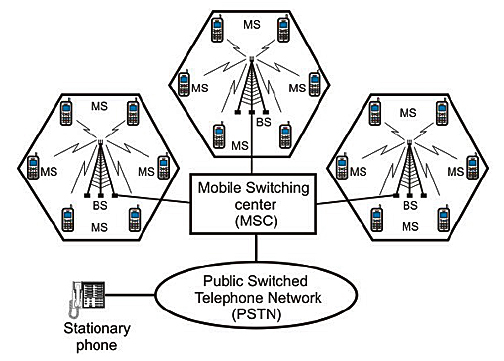
The industry needed a system that consumed little energy to enable small portable devices to operate on battery power. Cellular phones evolved to meet this need. Rather than adopt a point-to-point long-distance strategy, cellular phones link to a grid of local relay base stations. A cellular phone located anywhere in the grid links to the closest tower, which is connected to a mobile switching center to complete the call to the target device within that or any other cell, or to a stationary phone on the public network. Cell sites also have the unique ability to seamlessly hand off a call originating from a moving vehicle to an adjacent cell.
A progression of enhanced technical standards enabled compatibility among devices and opened the door to development of a rapidly expanding market. Efficient network management was the other key to development of advanced cellular communication systems in terms of speed, reliability, latency, capacity, and additional features.
The first generation of mobile networks, dubbed 1G, was introduced in Japan in 1979. It offered analog 2.4Kb/s with limited coverage and no roaming support. In 1991, 2G employed digital signaling to bump the speed to 64Kb/s and used the Global System for Mobile Communications (GSM) standard for improved voice fidelity and reliability. 2G also ushered in the ability to send text messages and photos.
3G was introduced in 2001 and harmonized global standards while also delivering 256Kb/s speeds. Additional functions included video conferencing, streaming and Voice over Internet Protocol (VoIP). The fourth and most common generation in use today, called Long-Term Evolution (LTE), can deliver speeds to 1Gb/s for high-definition video, internet access and gaming applications.
The Rise of 5G
We are now on the cusp of Generation 5, or 5G, which is designed to support the escalating demands of a universe of Internet of Things (IoT) – including an explosion of consumer video, telemedicine, telework and future autonomous transportation. In addition to increases ranging from 10 times to as much as 100 times present speeds, latency will be dramatically reduced. The ability to support many more connected devices with greater network efficiency and reduced latency is driving the transition to 5G.
Broad market adoption of 5G service will likely upend mobile cellular as well as fixed broadband markets. With speeds approaching those offered by cable and even fiber-to-the-home services, 5G has the potential to change the way consumers access the internet, disrupting established cable and DSL providers.
System engineers had to entirely rethink the architecture and technology of 5G cellular communication systems and deal with three different versions of 5G. To increase speed and system capacity, designers chose to utilize multiple higher-frequency bands, including millimeter wave (mmWave) frequencies of up to 52.6GHz. The higher the frequency, the greater the signal distortion due to attenuation over distance and through obstructions. Even heavy rain can reduce the effective range of mmWave transmissions.
In order to compensate for these losses, 5G cellular networks will require a major increase in the number of cellular antennas. Another part of the solution is the use of massive multiple-input multiple-output (massive MIMO) technology, enabled by base stations outfitted with up to 100 active antennas utilizing beamforming technology that can establish point-to-point links to individual devices.
A Race to Establish Dominance
The race to claim leadership in 5G technology has become a political issue between the US, China, South Korea and Japan. Countries that are first to implement 5G networks may get a head start in developing critical applications, including artificial intelligence, autonomous transportation, virtual reality, real-time healthcare and Industry 4.0 manufacturing technology. The jobs and revenue these applications generate will have a long-term impact on the economic health of nations for years to come.
The connector industry is poised to make major contributions to 5G infrastructure. Coaxial connectors and cable assemblies will play a major role in antenna-to-base station equipment. Long-distance fiber optic links will provide the most cost-effective connections from base stations to the network. Several connector manufacturers have expanded their antenna offerings to include 5G antennas.
Once 5G services are widely available in large metro areas, demand for 5G- compatible smartphones will accelerate. These advanced phones will utilize subminiature RF, stacking, and flat-flex cable connectors. Qualcomm estimates that 450 million smartphones will ship in 2021 and 750 million in 2022. Broad adoption of 5G will unleash entirely new categories of connected devices, all of which will utilize a wide variety of connectors.
The unique requirements of 5G networks have already spawned new connectors designed to address specific applications. The COVID-19 pandemic may temporarily slow the proliferation of 5G networks, but the momentum of this revolutionary technology will drive the next chapter in mobile connectivity.
Statements of fact and opinions expressed in posts by contributors are the responsibility of the authors alone and do not imply an opinion of the officers or the representatives of TTI, Inc. or the TTI Family of Companies.