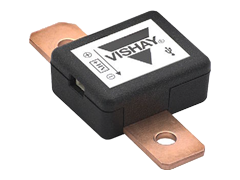
Vishay High Voltage Intelligent Battery Shunt
Vishay High Voltage Intelligent Battery Shunt (HV-IBSS) uses a single USB-C connector to power the circuit and emulate a serial interface so the user can conveniently read voltage, current, and temperature readings. The HV-IBSS includes a solid nickel-chrome alloy-resistive element that results in a reduced Temperature Coefficient of Resistance (TMR), minimizing the resistance variation over the operating temperature range. These HV-IBSS offers a measured current limit of up to ±500A. Typically applications include home automation, solar installations, battery management systems, and base station power supplies.
Features
- Precise/accurate:
- <0.2% factory two-point current calibration
- Shunt causes a maximum drift of 10ppm/K
- The maximum drift due to AFE and ADC is approximately 34ppm/K
- Versatile:
- M6 screws make it simple to connect to busbars and lugs
- Terminal emulation is available for a variety of operating systems
- USB-C connections for power and data
Applications
- Battery management systems
- EV test environment
- Home automation
- Industrial and server computing
- Industry and automation
- Networking, telecom, and base station power supplies
- Solar installations
Technical Specifications
| Parameters | Values |
|---|---|
| Ambient temperature range | -40°C to +75°C |
| Maximum power dissipation in shunt | 36W |
| Measured current limits | ±500A |
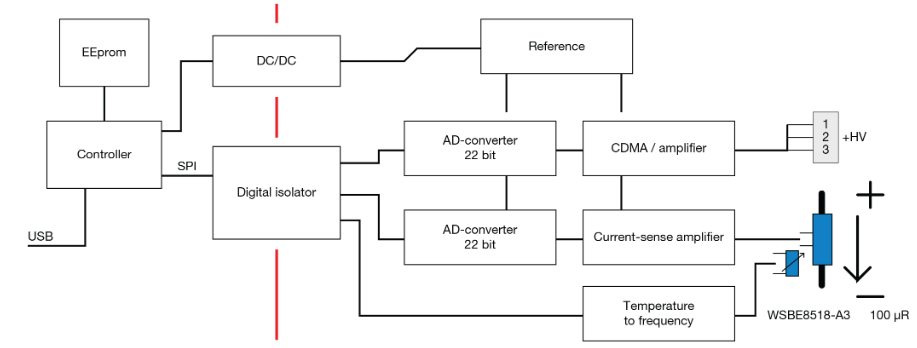
High Voltage Intelligent Battery Shunt Functional Block Diagram
Video
This TTI Tech Specs video explains the Vishay High Voltage Intelligent Battery Shunt uses a single USB-C connector to power the circuit and emulate a serial interface so the user can conveniently read voltage, current, and temperature readings.
See video transcript below
Video Transcript
“Shunt the front door!” That’s what my friends said when I showed them Vishay’s HV-IBSS-USB high voltage intelligent battery shunt. The reference design integrates the 100mΩ low TCR WSBE8518 Power Metal Strip shunt resistor with an analog front-end, 22-bit ADC, and a microcontroller for real-time monitoring of voltage, current, and temperature measurements over a USB Type-C connection. The design can measure current up to ±500A at up to 850V, with a maximum power dissipation of 36W, with two M6 screws connecting the busbar and lugs for easy evaluation. Factory two-point calibration coefficients are stored in EEPROM and deliver ±0.2% accuracy. The total TCR is 44ppm/°, but the resistor’s TCR is just 10ppm/°, ensuring precise measurements over the -40°C to +75°C ambient temperature range.