The global passive electronic components industry is built on scale: trillions of multilayer ceramic chip capacitors, chip resistors and ferrite inductors shipped each year into smartphones, automobiles, computers and industrial equipment. But a small and technically demanding segment of the industry works in the opposite direction. It takes those same mass-produced components and re-engineers them, one process at a time, to survive environments where a standard part would fail. These include defense electronics, civil aviation, spacecraft, downhole oil and gas instrumentation and implantable medical devices.
I refer to this segment as ruggedized customization services. It is a value-added layer of engineering that sits between the component factory and the mission-critical system, and it commands the highest profitability level for all passive components, price premiums and sticky customer relationships that are rare in the broader passive components market.
Defining the Market: Five Services Across Three Component Families
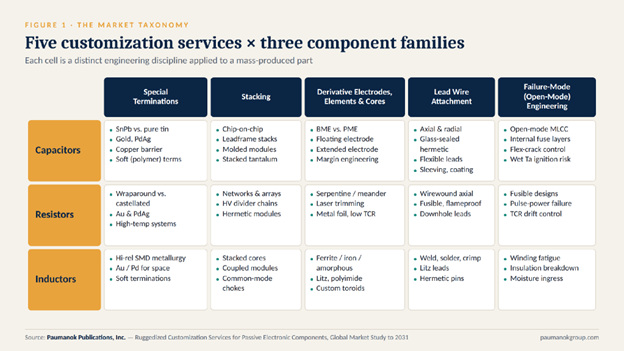
I organize ruggedized customization into five service categories applied to capacitors, resistors and inductors in our quest for finding synergistic technologies and business relationships:
- Special terminations: The ability for the factory to produce multiple types of component terminations, including tin-lead (Sn/Pb), gold, palladium-silver (Pd/Ag), copper-barrier and soft polymer termination systems that replace standard end metallurgy
- Stacking: Stacked multilayer ceramic capacitors-chip-on-chip, multi-anode lead-frame and molded module assemblies and resistor networks and arrays
- Derivative electrode, element and core configurations: Safety changes to the internal architecture of the component, including floating and extended electrodes in MLCCs, laser-trimmed and metal foil resistive elements and custom inductor cores and windings
- Lead wire attachment: Welding, soldering, crimping and laser bonding of leads for axial, radial and hermetic configurations
- Failure-mode engineering: Designing components that fail in an open-circuit condition rather than a short circuitSee summary below.
Figure 1: Five Customization Services Across Three Component Families
Sources: Paumanok Publications, Inc. Derived from Paumanok high-reliability component market studies, Zogbi TTI MarketEYE articles and Passive Component Industry Magazine.
Each of the fifteen intersections in the matrix above represents a distinct engineering discipline, with its own capital equipment, process know-how, qualification history and customer base. The market theory is that the area of rugged customization can add significant profitability to an individual passive component, but it requires a significant investment in advanced equipment and engineering. Our survey of companies that offer rugged customization can amplify their “per unit” profitability. Individual components will already offer performance parameters based upon voltage, frequency and operating temperature.
The Passive Electronic Component Supply Chain and the Rugged Customization Layer
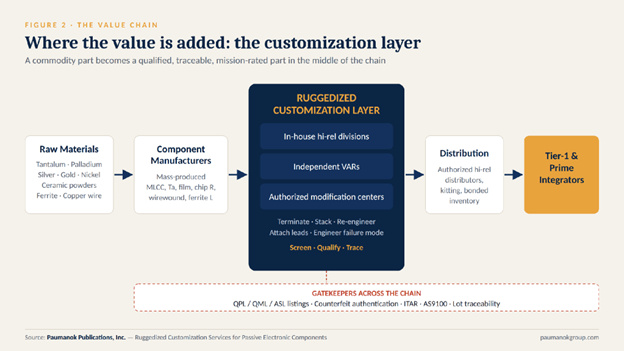
The supply chain begins with the strategic raw materials common to all passive electronic components: ruthenium, alumina, tantalum, palladium, silver, nickel, copper, barium, titanium and iron oxide – as well as a palette of rare earth additives, including both lanthanides and actinides used as additives to enhance part performance. Component manufacturers convert these into standard mass-produced, high-volume parts. Before those parts reach the original equipment manufacturer customer, they pass through a customization layer, where they are re-terminated, stacked, re-engineered, leaded, screened and qualified. This process adds a significant amount of value and profitability to the traditional high-reliability component production business model (See Figure 2).
Figure 2: The Value Chain for Ruggedized Passive Component Customization
Three types of participants operate in this layer:
- In-house hi-rel divisions of major component manufacturers, which control the base part and can modify it at the source
- Independent value-added resellers (VARs), which purchase standard components and re-terminate, screen and requalify them
- Authorized modification centers, which perform customization under the original manufacturer’s authorization and documentation
Authorized distribution plays an increasingly important role in delivering these services through kitting, bonded inventory and lot-controlled logistics. Across the chain, access is governed by:
- Qualified products lists (QPLs)
- Qualified manufacturers lists (QMLs)
- Approved sources lists (ASLs)
- Counterfeit authentication protocols
- ITAR
- AS9100 quality systems
I also note a clear move toward reshoring and regionalization of high-reliability customization capacity in North America and Europe over the past five years.
Capacitors: The Deepest Menu of Customization Services
Capacitors account for the broadest range of ruggedized customization activity. I have tracked the developments of value-added services in the capacitor industry for more than three decades (Nothing is more terrifying on the launchpad than a tin whisker). The technologies involved include ceramic (MLCC), tantalum, exotic plastic film, aluminum electrolytic, mica and carbon supercapacitors.
- Special terminations. Pure tin terminations – standard under RoHS – carry the risk of tin whisker growth, which can cause short circuits in space and defense hardware years after deployment. As a result, tin-lead terminations remain specified across defense and space programs. Gold and palladium-silver terminations serve space and medical markets, copper-barrier systems address aggressive thermal cycling and soft (polymer) terminations absorb board flex and mechanical shock.
- Stacking. Stacked MLCC and stacked tantalum assemblies improve volumetric efficiency (CV/cc) in chip-on-chip, leadframe-based and molded module formats. They are qualified to MIL-PRF-55681 and MIL-PRF-123, as well as to NASA- and ESA-approved configurations for space. This is a lucrative and profitable global market.
- Derivative electrodes. High-reliability ceramic designs balance various types of precious-metal electrodes, including palladium and silver but also the ability to employ platinum and gold. Floating electrode designs manage voltage breakdown as well as physical edge cracking, while extended electrode configurations and margin engineering improve flex-crack resistance and protect against moisture ingress.
- Lead wire attachment. Tinned copper, silver-plated copper and nickel leads are attached by welding, soldering, crimping or laser bonding, including glass-sealed leads for hermetic packages and flexible leads for vibration-intensive mounting.
MLCC Open-Mode Engineering
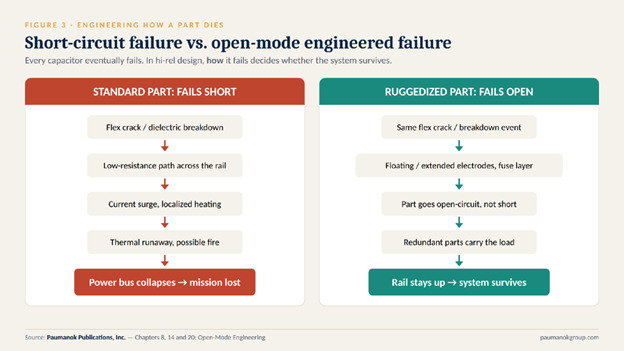
The most strategically important service in the capacitor segment is failure-mode engineering. A standard MLCC that cracks under board flex can create a low-resistance path across a power rail, leading to localized heating, thermal runaway and, in extreme cases, fire. An open-mode MLCC uses floating or extended electrodes, or internal fuse layers, so that the same event results in an open circuit. The system loses the capacitance of one part, but the power rail remains intact. I have conducted research into this segment, and a ceramic capacitor manufacturer’s ability to create a custom design that includes open-mode construction is a technical flex and adds significant value.
Figure 3: Short-Circuit Failure Vs. Open-Mode Engineered Failure
Resistors and Inductors
Resistors. Ruggedized customization spans thick film, thin film, wirewound, metal strip and network/array technologies. Key services include:
- Wraparound versus castellated terminations for military SEM-E and SIP modules. I have conducted research on this subject to ascertain market sizing and availability.
- Laser trimming and serpentine or meander element patterns for tight tolerances
- Metal foil resistive elements for ultra-low TCR precision applications. I have conducted research on this subject to ascertain market sizing and availability.
- High-voltage divider chains and hermetic resistor network modules for aerospace and space. I have conducted research on this subject to ascertain market sizing and availability.
- Fusible and flameproof designs that fail open safely under thermal overload. I have conducted research on this subject (tin-oxide and antimony 10 resistors) to ascertain market sizing and availability.
Inductors. For wirewound chip, multilayer, toroidal, shielded power and coupled inductors, customization centers on:
- Core material selection among ferrite, powdered iron and amorphous alloys
- Custom windings in exotic wire, heavy-build enamel and high-temperature polyimide
- Stacked cores, coupled inductor and transformer modules and common-mode choke stacks for defense EMI filtering
- Hermetic pin-through leads for space assemblies
The dominant failure mode in inductors is the open winding, caused by wire fatigue, thermal expansion mismatch and vibration fracture. Insulation breakdown and moisture ingress in offshore environments are also significant.
Vertical Markets for Ruggedized Customization
The majority of global demand for ruggedized customization services for passive electronic components comes largely from five vertical markets. In each case, the operating environment determines which customization services the market buys.
Figure 4: Five Vertical Markets and the Environments They Impose
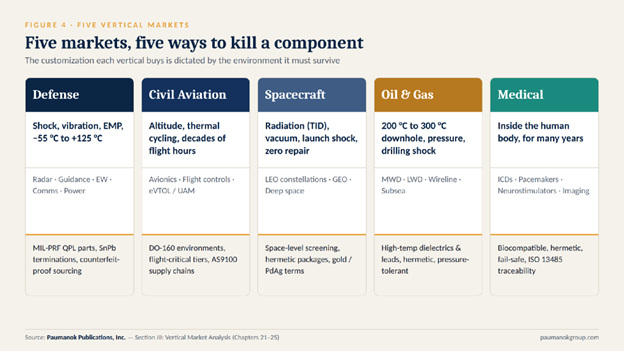
- Defense and military electronics. This is the largest and most established vertical, serving radar, guidance, electronic warfare, communications and power systems. Demand is supported by U.S. Department of Defense budget trends, munitions replenishment, counterfeit avoidance requirements and ITAR-governed sourcing.
- Civil aviation. Avionics and airframe electronics are qualified to DO-160 and DO-254, with AS9100 and AS9102 quality systems throughout the supply chain. The A320neo, B737 MAX and B777X programs sustain demand, while eVTOL and urban air mobility platforms add new electrified airframes.
- Spacecraft and satellite systems. Space-level qualification under MIL-PRF-123, ESCC, JAXA and NASA EEE-INST-002 includes radiation hardness and total ionizing dose requirements. I note a growing divergence between legacy space and the “new space” economy, where LEO constellations favor up-screened commercial parts at volume.
- Oil and gas. Measurement-while-drilling (MWD), logging-while-drilling (LWD), wireline and seismic tools require passive components that operate at 200°C to 300°C under extreme pressure and shock. This drives demand for high-temperature dielectrics, lead wires and ferrite cores and for hermetic, pressure-tolerant packaging.
- Medical devices. Implantable cardioverter defibrillators, pacemakers and neurostimulators require biocompatible, hermetic and fail-safe components. High-energy-density capacitors for ICD high-voltage charging circuits are among the most specialized passive components produced anywhere.
Qualification as a Barrier to Entry
In this market, the barrier to entry is qualification. Ruggedized components are subjected to burn-in, thermal shock and cycling, mechanical shock and vibration testing to MIL-STD-202, humidity bias and salt atmosphere testing, dielectric withstanding voltage testing, radiographic and acoustic microscopy inspection and HALT/HASS. Space and implantable applications frequently require 100% electrical screening rather than lot sampling.
Figure 5: Standards by Vertical and the Screening Gauntlet
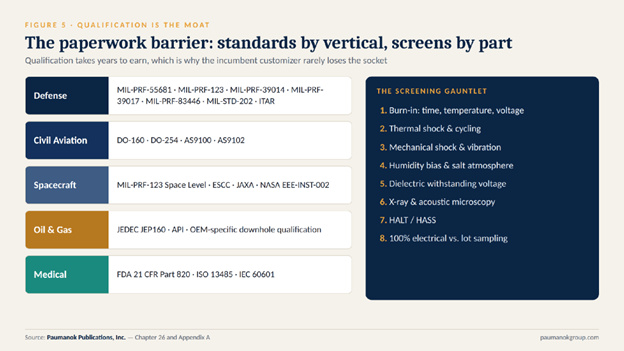
Qualification takes years to earn, and once a customized component is designed into a defense, aerospace or medical platform, the program rarely changes sources. This sustains price premiums and margins well above those of commodity passive components. It has also made failure analysis and root-cause laboratories a value-added market segment in their own right.
Market Outlook to 2031
I view demand for ruggedized customization services as structural rather than cyclical. The primary constraints on growth are on the supply side.
Figure 6: Drivers, Restraints and the Paumanok Equation
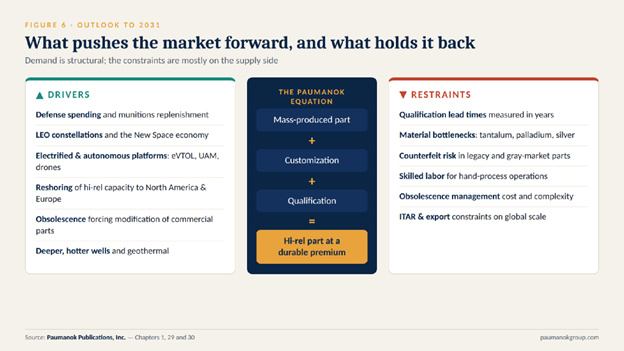
Drivers include:
- Defense spending and munitions replenishment
- LEO satellite constellations
- Electrified and autonomous platforms
- Reshoring of hi-rel capacity
- Obsolescence of legacy components, which pushes programs to modify commercial parts
- Deeper and hotter oil, gas and geothermal wells
Restraints include:
- Multi-year qualification lead times
- Tantalum, palladium and silver supply bottlenecks
- Counterfeit risk
- A limited pool of skilled labor for hand-process operations
- ITAR and export constraints on global scale
I also expect continued merger and acquisition activity, as larger component manufacturers seek to acquire qualified customization capacity rather than build it over a period of years.
Summary
Ruggedized customization services turn mass-produced capacitors, resistors and inductors into components that can survive the most demanding environments in electronics. Special terminations, stacking, derivative electrode configurations, lead wire attachment and open-mode failure engineering each add measurable reliability and value. Qualification requirements protect incumbents and sustain premium pricing.
In capacitors, I see the strongest opportunities in open-mode and flex-resistant MLCCs, tin-lead and soft-terminated chips, stacked ceramic and tantalum assemblies and high-energy-density capacitors for medical and pulsed-power applications. In resistors, I see opportunities in thin film and metal foil precision elements, high-voltage stacked divider chains and fusible designs for fail-safe operation.
In inductors, I see demand for high-temperature cores and windings, stacked and coupled power modules and EMI filtering chokes for defense platforms. As electronic systems become more autonomous, electrified and contested, these components will remain the invisible infrastructure of mission-critical electronics.
Dennis M. Zogbi is Chief Executive Officer and Founder of Paumanok Publications, Inc., and a longtime contributing analyst to MarketEYE.
Statements of fact and opinions expressed in posts by contributors are the responsibility of the authors alone and do not imply the opinion of the officers or the representatives of TTI, Inc. or the TTI Family of Specialists.
Follow TTI, Inc. on LinkedIn for more news and market insights.
Statements of fact and opinions expressed in posts by contributors are the responsibility of the authors alone and do not imply an opinion of the officers or the representatives of TTI, Inc. or the TTI Family of Specialists.
Follow TTI, Inc. - Europe on LinkedIn for more news and market insights.
Statements of fact and opinions expressed in posts by contributors are the responsibility of the authors alone and do not imply an opinion of the officers or the representatives of TTI, Inc. or the TTI Family of Specialists.