INTRODUCTION TO QUANTUM COMPUTING
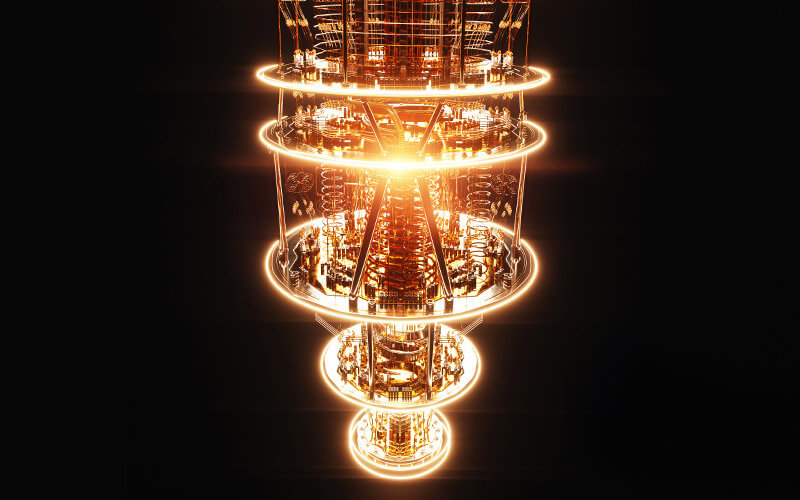
The quantum computing industry stands at a critical juncture where theoretical breakthroughs are rapidly translating into practical quantum systems capable of solving real-world problems. Central to this transformation is the development of passive electronic components that enable quantum systems to maintain coherence and operate with the precision required for a true quantum advantage.
This article provides a general analysis of the market for passive components – specifically capacitors, resistors and inductors – designed for quantum computing applications, examining the technologies and market dynamics that will shape this sector through 2030.
QUANTUM COMPUTING MARKET OPPORTUNITY
The global quantum computing market represents one of the most significant technological opportunities of the 21st century, with the potential to revolutionize fields ranging from drug discovery to financial modeling. Current quantum computers, while demonstrating quantum advantage in specific algorithms, remain largely experimental systems requiring extensive supporting infrastructure. The transition from research demonstrations to practical quantum systems drives unprecedented demand for specialized components that can operate in the extreme conditions quantum computers require. In theory, one day, every household and business will have a quantum computing system.
Quantum systems operate at temperatures approaching absolute zero, typically in the millikelvin range, while requiring precise control of electromagnetic signals across multiple frequency ranges. These operating conditions place extraordinary demands on passive components, which must maintain performance specifications that would be challenging even in conventional applications while functioning in environments that eliminate most traditional materials and design approaches.
The market context is further shaped by the diversity of quantum computing approaches, each presenting unique component requirements. Superconducting quantum computers, currently the most mature technology, require extensive cryogenic infrastructure and microwave control systems. This technological diversity prevents a one-size-fits-all approach to component development, creating market opportunities across multiple technical domains and for capacitor, resistor and inductor manufacturers who can offer a ruggedized custom solution.
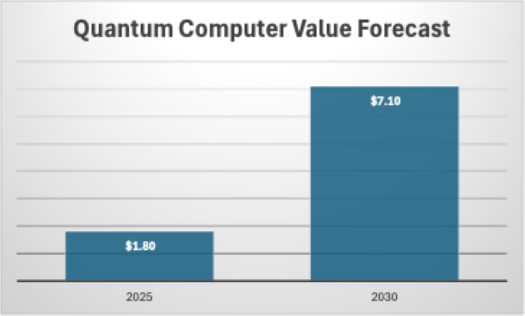
Government investments worldwide total over $15 billion in quantum technology development, with significant portions directed toward infrastructure and component development. Private investment has exceeded $2.5 billion annually since 2021, reflecting growing commercial interest and the proximity of practical applications. This investment environment supports component vendors willing to invest in specialized capabilities and accept longer development timelines than typical commercial markets. The forecast for quantum computer market value globally is estimated below.
Market Value Forecasts
The quantum computing hardware market is estimated at $1.8 billion in 2025 and is expected to grow to $7.1 billion by 2030. Passive electronic components are a fraction of that value but represent a market opportunity for bespoke vendors who cater to a demanding clientele.
Quantum Computer Hardware Value Forecast: Global: FY 2025-2030
Source: Paumanok Publications, Inc. “Passive Electronic Components in Quantum Computing: World Markets, Technologies and Opportunities”: 2025-2030 ISBN: 1-89-3211-38-X (QPU2025)
End Markets Driving Quantum Computer Demand Through 2030
We estimate that the key end markets that will drive quantum computing demand through 2030 are as follows:
Pharmaceutical and Healthcare
This sector represents one of the most promising near-term applications. Quantum computing could provide a way to optimize and accelerate the identification of potential drugs by simulating molecular interactions.
Financial Services
For customer targeting and prediction modeling, quantum computing could be a game changer. The data modeling capabilities of quantum computers are expected to prove superior in finding patterns, performing classifications and making predictions that are not possible.
Supply Chain Management
Quantum computers can help solve very large logistics optimization problems.
Manufacturing and Materials Science
Quantum computing can assist with material design and discovery as well as quality control and predictive maintenance.
Why These Markets Drive Demand for Quantum Computing
Problem complexity: These sectors face optimization problems with exponential complexity that classical computers struggle with – exactly where quantum computers offer potential advantages.
High potential return on Investment: The potential cost savings and revenue increases justify significant quantum computing investments.
PASSIVE ELECTRONIC COMPONENT SUPPORT TECHNOLOGIES - PERFORMANCE SPECIFICATIONS AND REQUIREMENTS
The performance requirements for passive components in quantum computing systems far exceed those of conventional microwave and RF applications. While traditional telecommunications might tolerate insertion losses of 1-3 dB, quantum applications often require losses below 0.1 dB to preserve quantum state coherence across measurement and control operations. This demanding specification drives fundamental innovations in materials, design methodologies and manufacturing processes.
Loss Characteristics and Measurement Standards
The measurement and specification of loss characteristics in quantum applications requires unprecedented precision and standardization. While conventional microwave measurements might specify loss to ±0.1 dB accuracy, quantum applications often require uncertainty levels below ±0.02 dB to enable meaningful system optimization. This drives development of specialized measurement techniques, calibration standards and traceability protocols specifically for quantum applications.
Temperature Stability and Cryogenic Performance
Cryogenic operation fundamentally alters the behavior of materials and electromagnetic structures, creating unique challenges for component design and specification. Most materials exhibit different thermal expansion coefficients, electrical conductivities and magnetic properties at cryogenic temperatures compared to room temperature operation. Component designs must account for these changes while maintaining performance specifications across the entire temperature range.
Power handling at cryogenic temperatures often differs significantly from room temperature ratings, as thermal dissipation becomes much more challenging in the quantum operating environment. Components must be derated for cryogenic operation with typical derating factors ranging from 2:1 to 10:1, depending on the specific application and thermal environment. This drives development of specialized power handling test methods and rating procedures.
Noise Figure and Phase Stability Requirements
Noise performance in quantum applications extends beyond traditional noise figure specifications to include quantum-limited noise characteristics and correlation effects. Passive components can contribute to thermal noise, shot noise and quantum back-action that limits system performance. Understanding and minimizing these effects requires sophisticated noise models and measurement techniques specifically developed for quantum applications.
Long-term stability requirements extend beyond conventional component specifications to include quantum coherence preservation over extended periods. Components must maintain performance specifications over months or years of continuous operation while contributing minimal decoherence to quantum states. This requires understanding of aging mechanisms specific to cryogenic operation and development of appropriate qualification and reliability testing protocols.
Custom Passive Parts- Heavy Customization
The passive electronic components consumed in cryogenic quantum systems require heavy customization because of processing speeds and low-temperature environment. Vendors who currently supply quantum systems with capacitors, resistors and inductors are familiar with custom circuits in challenging environments that usually involve voltage, frequency or temperature and have end-use customers in aerospace, oil & gas, electronics and medical markets.
Passive Component Sub-Categories for Next-Generation Computing
The following specialized segments of the custom passive electronic component industry include capacitors, resistors and inductors that are enabling technology for next-generation computing success:
CAPACITORS FOR QUANTUM SYSTEMS
The following represents the types of fixed capacitors consumed in cryogenic quantum systems:
Ceramic Microwave Capacitors
High-frequency, multi-layered and single-layered porcelain ceramic and composition ceramic capacitors have been identified as enabling technologies for use in quantum systems. Signal conditioning, high-frequency filtering and RF isolation in quantum control electronics require bypass, decoupling and filtering through volumetrically efficient capacitors. These capacitors experience the highest consumption rates in quantum systems, primarily due to their exposure to rapid thermal cycling and high-frequency electromagnetic fields. P90 Porcelain, X7R and C0G/NP0 ceramic formulations show the best temperature stability, but even these exhibit significant parameter drift at quantum computing temperatures. Consumption rates are typically 15-25% higher than in conventional computing applications.
Film Capacitors for Cryogenic Applications
Polyethylene terephthalate (PET) and polypropylene (PP) film capacitors designed specifically for cryogenic environments are essential for power supply filtering and energy storage in quantum systems. While more expensive than ceramic alternatives, specialized cryogenic film capacitors demonstrate superior longevity in high-voltage electrostatic power supplies in such a unique environment. The specialized nature of these components results in consumption costs that are three to four times higher per unit compared to standard film capacitors.
Silicon Capacitors
Silicon capacitors produced through ion implantation devices are used in Josephson junction circuits and quantum bit (qubit) implementations where conventional dielectrics would introduce unacceptable noise parasitism. The three types of silicon capacitors employed for decoupling the processor are manufactured using ion implantation equipment traditionally used for semiconductor production instead of traditional discrete components. The silicon capacitors are near the QP processor, which makes their performance requirements minimal. Note also the development of the hexagonal boron nitride dielectric for decoupling the QPU.
Polymer Tantalum and Aluminum Electrolytic Capacitors
While rarely used in the quantum processing core, these capacitors find application in power supply circuits and non-critical support systems. Solid polymer tantalum and aluminum capacitors are preferred for volumetric efficiency and solid-state polymer design.
Hexagon Boron Nitride Decoupling Capacitors
MIT has developed new capacitors for decoupling the quantum processor made from hexagonal boron nitride. This is a new development in capacitance dielectric, with the complex structure of the boron nitride providing surface area and greater capacitance.
Other – (Niobium) Capacitors
We note the use of niobium capacitors in low-temperature applications. The extreme temperature gradients experienced during quantum computer operation create mechanical stresses that exceed the design parameters of most capacitor types.
RESISTORS FOR QUANTUM SYSTEMS
The following represents the types of resistors consumed in cryogenic quantum systems:
TaN, NiCr and SiCr Thin Film Resistors
Precision thin film resistors are consumed in current sensing, bias networks and precision voltage dividers in quantum control electronics and employ the following thin film solutions:
- Tantalum Nitride (TaN): Excellent temperature stability and low noise characteristics
- Nichrome (NiCr): Good temperature coefficient control and non-magnetic properties
- Silicon Chromium (SiCr): Superior high-frequency performance and low parasitic effects
These resistors experience moderate consumption rates but require extensive pre-screening and matching. Precision thin film resistors typically cost two to three times more than standard versions due to tighter tolerance requirements and cryogenic qualification testing.
Bulk Metal Foil Resistors
Bulk metal foil resistors are based upon nickel chromium foil and used in less critical applications where cost considerations outweigh ultimate precision requirements. Bulk foil offers good long-term stability in cryogenic environments.
Wirewound Precision Resistors
Nickel-chromium wirewound resistors are consumed in high-power applications, precision current sensing and applications requiring exceptional long-term stability.
- Non-inductive winding: Essential for high-frequency quantum control applications
- Magnetic shielding: Special core materials to minimize magnetic coupling
INDUCTORS FOR QUANTUM SYSTEMS
The following represents the types of inductors consumed in cryogenic quantum systems:
Ceramic Chip Inductors for Surface Mount Applications
High-frequency ceramic chip inductors are consumed for high-frequency filtering and impedance matching in quantum control electronics.
- Multilayer ceramic inductors: High-frequency applications with good temperature stability
- Thin film inductors: Ultra-precise inductance values with minimal tolerances
- Wirewound chip inductors: Higher inductance values with good current handling
Air Core RF Inductors
Air core RF inductors are consumed for high-frequency filtering, impedance matching and RF isolation in quantum control electronics.
- Ultra-stable winding geometry: Maintain inductance stability under thermal cycling
- Low-loss conductor materials: Silver or copper windings with specialized surface treatments
Air core RF inductors for quantum applications cost three to five times more than standard versions due to precision winding requirements and cryogenic qualification testing.
Ferrite Core Inductors
Ferrite core inductors are consumed in power supply filtering and common-mode noise suppression in quantum system support electronics.
- Temperature-stable ferrite compositions: Materials maintaining permeability stability at low temperatures
- Low-loss ferrite grades: Minimizing core losses that could generate electromagnetic interference
- Non-magnetic packaging: Avoiding ferromagnetic materials in component housings
Toroidal Core Inductors
Toroidal core inductors are consumed for common-mode filtering, power supply applications and EMI suppression in quantum system peripherals.
Core Material Selection
- Powdered iron cores: Good temperature stability and moderate cost
- Amorphous metal cores: Superior high-frequency performance
- Nanocrystalline cores: Exceptional permeability stability
Superconducting Thin Film Inductors
Josephson junction circuits, qubit control and quantum flux devices where conventional inductors would introduce unacceptable energy dissipation.
- Niobium (Nb) inductors: Operating well below superconducting transition temperature (9.2K)
- Aluminum (Al) inductors: For applications requiring lower transition temperatures (1.2K)
- High-Tc superconductor inductors: Experimental applications using YBCO or similar materials
Individual superconducting inductors can cost $1,000 to $10,000 each due to specialized fabrication requirements.
SUMMARY
In the capacitor space, we see market opportunities for microwave ceramic capacitors, silicon capacitors, solid polymer capacitors, as well as the development of exotic capacitor solutions. In resistors, we see the use of high-frequency thin film resistor designs of tantalum nitride, nichrome or chrome silicide resistor systems as well as precision nichrome resistors in metal foil, film and wirewound configurations. For inductors, we see opportunities for ceramic chip, air core, ferrite core, toroidal core and superconducting thin film inductors based upon niobium, aluminum or high Tc -superconductor materials.
Follow TTI, Inc. on LinkedIn for more news and market insights.
Statements of fact and opinions expressed in posts by contributors are the responsibility of the authors alone and do not imply an opinion of the officers or the representatives of TTI, Inc. or the TTI Family of Specialists.
Follow TTI, Inc. - Europe on LinkedIn for more news and market insights.
Statements of fact and opinions expressed in posts by contributors are the responsibility of the authors alone and do not imply an opinion of the officers or the representatives of TTI, Inc. or the TTI Family of Specialists.