The following chart (Figure 1) illustrates the global lead times and corresponding global market value of consumption in U.S. dollars for 53 types of passive electronic component (capacitors, resistors and inductors. After three years of financial tightening designed to restrain the strong dollar, demand, lead times and related valuations have all flattened out through the end of the June quarter (June 25, 2025).
Figure 1. Lead Times for 53 Types of Passive Components: Clear Trends and Direction
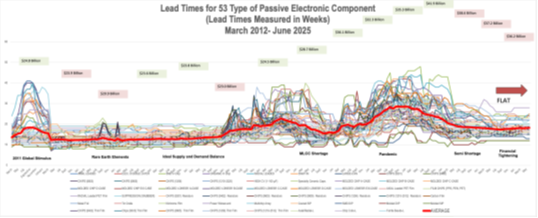
©2025 - Dennis M Zogbi, Paumanok Publications, Inc. Updated June 2025. Source: “Passive Electronic Components: World Market Outlook: 2025-2030 ISBN #:1-893211-99-1 (2025)”
CAPACITOR MARKET UPDATE
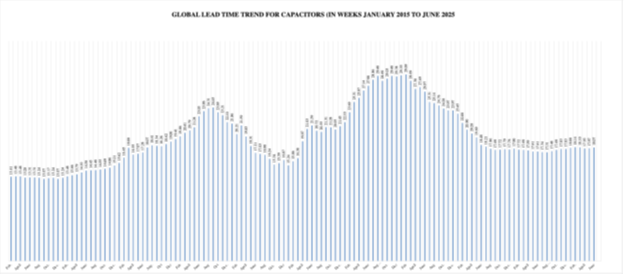
Capacitor lead times and demand increased slightly in June 2025 on a month-to-month basis. Increased demand was noted in snap-mount aluminum electrolytic and radial leaded aluminum electrolytic capacitors as well as for metallized polypropylene film dielectric capacitors used for snubbing IGBT semiconductors. Meanwhile, weakness was noted in large case size MLCC and tantalum remain unchanged (See Figure 2).
Figure 2. Global Lead Time Trend for Capacitors (Measured in Weeks): January 2015 to June 2025
Source: Capacitors: World Markets, Technologies and Opportunities: 2025-2030 ISBN #:1-893211-99-1 (2025)
The chart above is a visual interpretation of the collective data for 44 types and configurations of capacitors monitored by Paumanok IMR and shows that the global capacitor markets have displayed stable lead times over the past 120 months, following years of turmoil. June showed a slight upward trend in lead times on a month-to-month basis due to movement in snap mount and radial leaded aluminum capacitors and snubber plastic film capacitors.
MLCC Ceramic Capacitors
Ceramic capacitor markets have been stable for the past five months; showing very little signs of activity, but the markets continue to outperform other parts we cover in this article, and the outlook for FY 2026 remains extremely positive for MLCC for AI chipset decoupling and EVx propulsion circuits in charger, inverter, converter and battery management systems. We forecast that MLCC revenues are going to increase to support strengthening yen and won to the U.S. dollar.
Emerging markets in chipset decoupling and electric vehicle propulsion have unique operational requirements for performance based upon high voltage, high temperature and high frequency operations, which limit the number of global vendors who can participate. This is keeping all enabling technologies associated with artificial intelligence and electric vehicle propulsion at a high dollar valuation.
Aluminum Capacitors
The aluminum electrolytic capacitor data has demonstrated volatility for the first six months of the year, with weakness in certain parts of the market offset by activity in other parts of the market (radial and snap-mount). We note that this dielectric is clearly impacted by tariffs on its global ecosystem, with vendors moving parts in response to the volume of raw material per part and its production location. Most aluminum electrolytic capacitors are produced in China, Japan, Korea, Indonesia and Malaysia.
Tantalum Capacitors
The tantalum electrolytic data suggests an increase in demand from AI chipsets for decoupling, SSD for storage and electric vehicle propulsion—a net new market for tantalum capacitors. Directionally, the markets had been trending upward in February and March 2025 but dropping suddenly in April and May and then settling in June 2025 on a month-to-month basis. We noted increased demand for the D, E and X case size chip (EIA case measured in inches) in the first quarter of CY 2025. Most tantalum capacitors are produced in China, Mexico, Czech Republic, Thailand and Japan.
Plastic Film Capacitors
Lead times and demand for plastic film capacitors—which are key in renewable energy systems, PHEV and EVx propulsion—have been elevated for some time; however, there was stagnancy in all plastic dielectric film (OPP, PET, PEN and PPS) product lines over the past three months with clear declines noted in axial leaded (automotive) and suppression (industrial automation and infrastructure). We note in June 2025 that demand has increased for the IGBT snubber capacitors consumed in interference suppression circuits in industrial automation equipment and dive assemblies. Most plastic film capacitors are produced in China, Japan and Germany.
RESISTORS MARKET UPDATE
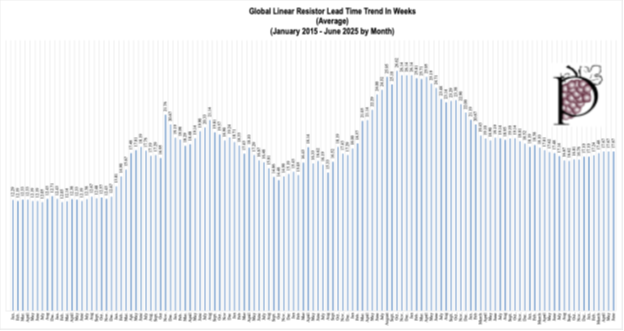
In June 2025, resistor lead times have remained unchanged. This is a key economic indicator because of the ubiquitous nature of thick and thin film chip resistors in the high-tech supply chain. The supply chain is extremely sensitive and the shift in demand, even slightly, is reflective of the true state of actual demand from customers who are replenishing inventories.
Fixed linear resistors in chip format are amongst the highest volume and lowest priced essential products on every printed circuit board. The value of the industry has been relegated to a few global vendors with massive economies of scale in Japan and China. In June, there was some upward demand in the 0402 thick film chip consumed in handsets and tablets, but this was offset by a slowdown in consumption of the 0603 thin film chip (EIA case sizes In inches). Activity in legacy axial and radial leaded resistors saw increased activity through April 2025 but then had a slowdown in May and June. Resistor networks, arrays and IPDs have remained unchanged for the majority of the year with some slowdown noted in the SMD DIP Network.
(See Figure 3).
Figure 3. Global Lead Time Trend for Resistors (Measured in Weeks): January 2015 to June 2025
Source: Resistors: World Markets, Technologies & Opportunities: 2025-2030 ISBN # 0-929717-02-3 (2025)
Thick Film Chip Resistors
Demand for thick film chip resistors has been growing each month since December 2024 and escalating from January through March 2025. It then suddenly stabilized in May and April 2025 and then increased again in June 2025 on a month-to-month basis. We noted increasing lead times for all thick film chip case sizes from 0201 to 1206 from January to June 2025 as customers replenish inventories. Most thick film chip resistors are produced in China and Japan.
Thin Film Resistors
In the first six months of 2025, the market for thin film resistors began to increase as well, especially in 0402 to 1206 case sizes (similar to their thick film counterparts). This market showed signs of slowdown in the smaller cases sizes in June but remained elevated and steady in the larger case sizes through June 25, 2025. Most thin film chip resistors are produced in Japan and China.
Resistor Networks
This product line has been very stable for the past six months (from November 2024 to June 2025) with no change in lead times for Arrays, SIPs and DIPs. Most of these products are manufactured in Mexico, Germany and Japan.
Axial And Radial Leaded Resistors
Axial and radial leaded resistors, especially those consumed in high-voltage applications, showed increased demand in June on a month-to-month basis including tin-oxide, carbon film and nichrome film axial and radial leaded resistors. Most of these products are manufactured in the U.S., Germany and Japan.
MAGNETICS MARKET UPDATE
Discrete Inductors
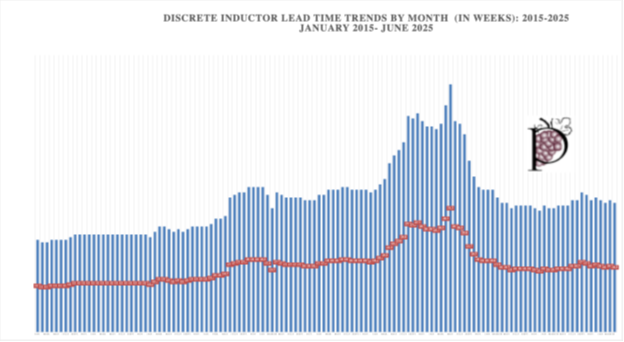
Discrete inductor demand showed growth in June 2025 followed by a slowdown in April and May 2025 on a month-to-month basis. Chip coils and ferrite beads, both consumed in mass produced products such as handsets, portable computers and games, saw a sharp slowdown in April on a month-to-month basis, followed by an increased in June. Chip inductors are consumed in handsets, computers and TV sets and for applications in AI chip set decoupling and electric vehicle propulsion. (See Figure 4).
Figure 4. Global Lead Time Trend for Inductors (Measured in Weeks): January 2015 June 2025
Source: Source: “Passive Electronic Components: World Market Outlook: 2025-2030 ISBN #:1-893211-99-1 (2025)”
The above chart is a visual interpretation of the collective data for three types and configurations of discrete inductor monitored by Paumanok, showing the overall market volatility over the past 120 months.
STRONG DOLLAR!
In June 2025, the currency exchange rates for the yen, won and NT dollar strengthened as the U.S. dollar weakened in value, as forecasted. The 2024 spike in yen, won and NT dollar impacted revenues in U.S. dollars for that year, and a strengthening of the yen and won to the U.S. dollar is noted in the chart below for June 2025.
Figure 5.0. Currency Value to The U.S. Dollar Comparison: Annualized: 2018-2025 (1q and 2q)
| Year | 2018 | 2019 | 2020 | 2021 | 2022 | 2023 | 2024 | 2025 Q1 | 2025 Q2 |
| Yen | 107 | 110 | 106 | 110 | 132 | 139 | 151 | 152 | 144 |
| Won | 1080 | 1165 | 1183 | 1149 | 1299 | 1308 | 1356 | 1442 | 1389 |
| NTS | 29 | 31 | 29 | 28 | 30 | 32 | 32 | 33 | 33 |
©2025 - Dennis M Zogbi, Paumanok Publications, Inc. Updated June 2025 Source: “Passive Electronic Components: World Market Outlook: 2025-2030 ISBN #:1-893211-99-1 (2025)”
Paumanok Publications, Inc. is the world's largest supplier of market research and consulting services to the passive electronic component industry. For 36 years, Paumanok has supplied research products and services for trade companies and private equity firms that have a financial interest in or are directly involved in the supply chain for capacitors, resistors, inductors and circuit protection components as well as the engineered materials and ores associated with their key functions.
Follow TTI, Inc. on LinkedIn for more news and market insights.
Statements of fact and opinions expressed in posts by contributors are the responsibility of the authors alone and do not imply an opinion of the officers or the representatives of TTI, Inc. or the TTI Family of Specialists.
Follow TTI, Inc. - Europe on LinkedIn for more news and market insights.
Statements of fact and opinions expressed in posts by contributors are the responsibility of the authors alone and do not imply an opinion of the officers or the representatives of TTI, Inc. or the TTI Family of Specialists.