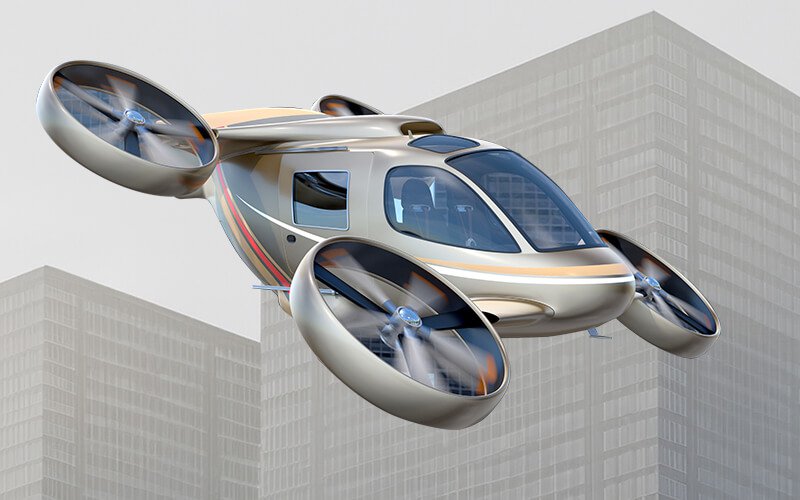
According to an Uber report, an average San Francisco resident spends nearly two hours commuting from San Francisco’s Marina to work in downtown San Jose. Now, imagine slashing that same commute time to only 15 minutes. A commercial electric vertical take-off and landing (eVTOL) aircraft can make that happen.
eVTOL aircraft offer a promising future as a zero-emission, sustainable urban and military transportation solution. They use electric propulsion and vertical lift technology to take off and land without requiring a runway. As such, eVTOLs are expected to provide critical links between different types of connected transit, including aerial taxis, delivery vehicles, emergency medical transport and military passenger and cargo transportation.
According to the Market Research Future, the global eVTOL aircraft market is projected to reach $4.46 billion by 2030, at a compound annual growth rate (CAGR) of 30.3%. Infrastructure investments and advances in key eVTOL technologies, like electric propulsion, battery systems and autonomous flight capabilities will define the growth trajectory.
This emerging market also impacts the electronics industry, presenting new challenges and opportunities to system design engineers.
eVTOL – A System Overview
The essential components of eVTOL design are an electric propulsion system, advanced battery technologies, safety systems and autonomous capabilities.
Electric Propulsion System
eVTOLs utilize electric propulsion motors, which are quieter and more environmentally friendly. Certain eVTOL designs utilize multiple electric motors, each driving a rotor or propeller providing the lift for vertical takeoff and landing. The number of these motors and their configurations can vary across designs. Some designs use fewer powerful motors for increased efficiency. A distributed propulsion system (DEP) design uses multiple smaller motors to enhance redundancy and safety. If one motor fails, the aircraft can use the other motors safely. DEP also allows for precise control, enhancing smoother and stable flight operations.
Efficient Battery Technology
Hydrogen fuel cells, solid-state batteries and lithium-ion batteries are commonly used to power eVTOLs. Battery energy density, power output, charging speed and weight directly impact the effectiveness of eVTOL propulsion systems and, as such, the range and performance of the aircraft.
Urban air mobility applications require lightweight batteries yet can deliver high energy density. This balance is crucial because heavier batteries restrict the aircraft’s range and limit its ability to carry passengers or cargo. Significant breakthroughs in battery technology are essential to realizing the full potential of eVTOL transportation.
An Uber study outlined that to achieve a range of 100 miles, eVTOL vehicles would require a battery with an energy density of roughly 230 WH/Kg. Factoring in an average system-induced efficiency reduction by 40-50%, the battery pack’s energy density would still need to be higher (380-460 WH/Kg).
Currently, limitations in battery design are keeping eVTOL aircraft range much lower than 100 miles.
Autonomous Capabilities
There is an increasing interest in adding autonomous capabilities to eVTOL aircraft. Minimizing human intervention to eliminate human pilots can make eVTOLs an economically viable urban transportation option.
eVTOLs use an autonomous flight control (AFC) system with sensors to perceive altitude and speed. Advanced flight control algorithms can ensure stable and precise flight operations. The system also automates real-time decision-making by smoothly adapting to changing conditions.
eVTOL aircraft use autonomous communication systems to coordinate with air traffic control, sensor-based intelligence to detect and avoid obstacles and autonomous takeoff and landing systems.
When integrating autonomous capabilities in eVTOLs, system designers must evaluate the safety and reliability ratings of the electronics and algorithms to make the design robust and adaptive. The ability to operate in complex urban environments with minimal human oversight is key to the overarching vision of making local air travel more affordable to the public.
eVTOL Design Considerations
Due to battery limitations, minimizing the gross takeoff weight, which includes the weight of avionics, related interconnects and cabling is important.
The connector components should optimize size, weight and power (SWaP) for line-replaceable units (LRUs). Since vertical takeoff and landing of eVTOLs employ high amounts of electrical power, design engineers have to use connectors that can handle high voltages and high peak power (kW) output for eVTOL electric propulsion motors, controllers, batteries, inverters, sensors and infotainment systems.
Safety is a prime consideration in aviation system design, and eVTOLs are no exception. The peak amperage ratings during maneuvers and unplanned and planned landings demand extra robust connectors. The interconnects you use must also handle vibration and shock without compromising the connection’s integrity.
Designing inflight subsystems involves a variety of electronic components. For example, low-voltage, high-bandwidth connectors may be suitable in inflight entertainment (IFE) systems, while high reliability is essential for mission-critical systems like avionics, AFS and navigation.
TTI: Your Trusted Partner in eVTOL Design
The eVTOL market's growth is driving the need for reliable electronic components to meet the unique design demands of these aircraft. At TTI, we recognize the challenges faced by eVTOL design engineers, and we are committed to providing the interconnects and other components that meet your design requirements. Whether it's commercial grade or military specification (MIL-SPEC), our team can help you find the correct connector for your eVTOL design from our vast collection of high-quality electronic components from trusted manufacturers like Amphenol, Aptiv, ITT Cannon, Molex, Phoenix Contact and TE Connectivity.
Follow TTI, Inc. on LinkedIn for more news and market insights.
Statements of fact and opinions expressed in posts by contributors are the responsibility of the authors alone and do not imply an opinion of the officers or the representatives of TTI, Inc. or the TTI Family of Specialists.
Follow TTI, Inc. - Europe on LinkedIn for more news and market insights.
Statements of fact and opinions expressed in posts by contributors are the responsibility of the authors alone and do not imply an opinion of the officers or the representatives of TTI, Inc. or the TTI Family of Specialists.