Diagram Of A Bridge Rectifier
What is a Bridge Rectifier?
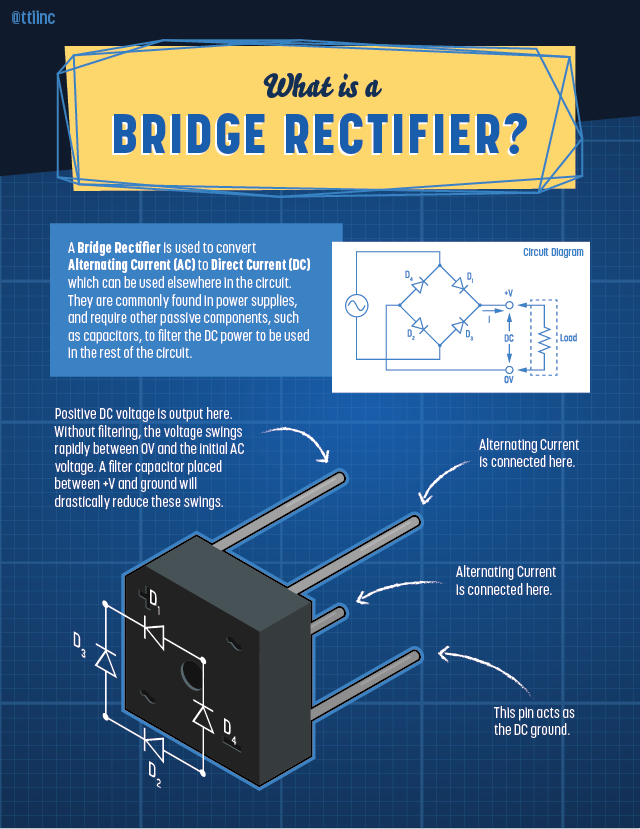
A Bridge Rectifier is used to convert Alternating Current (AC) to Direct Current (DC) which can be used elsewhere in the circuit.
How does a Bridge Rectifier work?
According to the diagram above, the positive DC voltage output is located at a top pole. Without filtering, the voltage swings rapidly through poles between 0V and the initial AC voltage. A filter capacitor placed between +V and ground will drastically reduce these swings. Two poles on opposite sides connect the alternating current, a bottom pole acts as the DC ground.
What applications use Bridge Rectifiers?
They are commonly found in power supplies and require other passive components, such as capacitors, to filter the DC power to be used in the rest of the circuit.
Looking for bridge rectifiers? Search TTI's Inventory