The Rise of Single Pair Ethernet in Industrial Spaces
10.01.2021 // Amphenol ICC
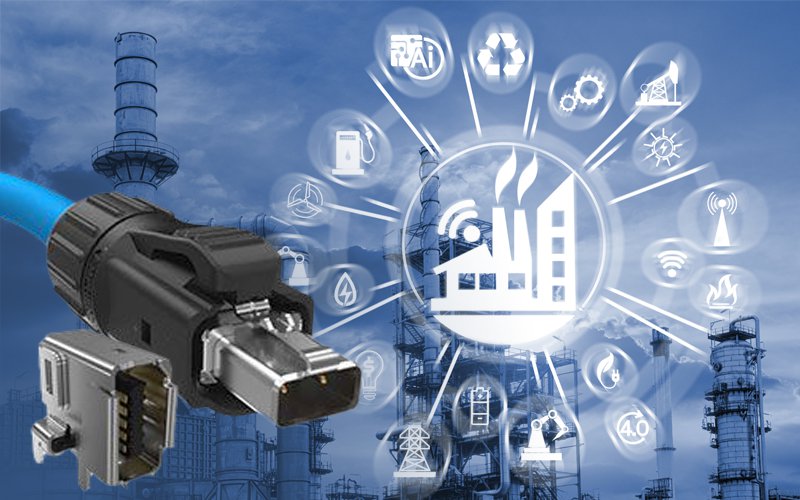
Although Ethernet technology has been around for decades, it was primarily utilized in corporate office settings but not in industrial applications due to the delicate cables used to connect systems. However, the rising popularity of Single Pair Ethernet (SPE), coupled with the proliferation of automation in manufacturing, has increased adoption of the protocol in industrial spaces, which requires ruggedized components to withstand harsh conditions.
Use of SPE for industrial applications accelerated even more after the International Electrotechnical Commission issued IEC 63171-6 in early 2020, establishing a standard for SPE interfaces and cabling components. Ethernet has been expanding into Industrial spaces at a rapid pace. In fact, a study by HMS Networks shows that in 2020, industrial Ethernet increased its market share to 64 percent of new installed nodes, compared to 59 percent in 2019. Fieldbuses—the traditional industrial connectivity protocol—dropped to 30 percent of the market in 2020, from 35 percent in 2019.
The standardization of SPE throughout industrial workspaces allows the same language of communication to be used between modules, from sensors all the way up to the cloud. As industrial operations integrate cloud-based communications into their processes, embrace the Industrial Internet of Things (IIoT) and demand lower latency required for full automation, they are turning to SPE solutions to enhance communication compared to the traditional Fieldbus protocol. Meanwhile, manufacturers are working together to promote IEC 63171-6-compliant solutions, developing an ecosystem that will empower industrial operations to take advantage of cutting-edge connectivity and technology.
A NEW CABLING APPROACH
Traditionally, Fieldbus technology has been the network system of choice for industrial applications due to its rugged infrastructure, but it can be slow, expensive and complex, typically requiring protocol conversion gateways to communicate with other systems. Ethernet connectivity is much more reliable, rapid and wide ranging, eliminating any language conversion devices. But because it was initially designed for commercial environments, it lacked the robust features necessary to operate in industrial conditions.
The advance of multipair Ethernet and modular jack interfaces allowed the protocol to be adopted in some industrial settings, but multipair industrial cables are large, bulky, typically only cover short distances and are intended for high bandwidth applications. Additionally, traditional modular jack interfaces use delicate plastic latching stems that can easily be broken off in an industrial workspace.
One early market force that drove the widespread adoption of SPE was the automotive industry, where the smaller cables were used due to their lighter weight and lower use of copper materials, which reduces costs of the solution. Industrial application of SPE is focused on communication with discrete devices such as sensors and actuators, usually with lower bandwidth requirements due to their dedicated functionality. Weight and bulk reduction in a factory setting is critical as well, especially for robotic operations or when cables have to be run a long distance between small sensors and primary control cabinets.
Compared to traditional cabling approaches, SPE cables are half the size and can reach up to ten times the distance of multipair Ethernet. SPE connectors are specifically designed for industrial environments, with mechanically tough housings, shielding and cable termination features. SPE systems also use a metal latching system, creating a much more robust and reliable connection between the plug and receptacle.
STANDARDIZING SPE COMPONENTS
Although SPE has emerged as an optimal solution for industrial applications, adoption requires updating a variety of components and systems. IEC 63171-6 aims to ensure that all connectors developed for the industrial ecosystem can operate together in rugged environments by defining electrical performance requirements and mechanical form factors for the SPE interface.
Components such as chips, magnetics, connectors and cabling must be interoperable and meet shock, vibration, temperature, thermal cycling, humidity and ingress protection requirements under IEC 63171-6.
Due to the interconnected nature of SPE, a group of manufacturers started the SPE Industrial Partner Network to assure the quality for uniform and coordinated SPE infrastructure that meets IEC standards. Members of the partner network represent various aspects of SPE, from chips to magnetics to cabling and connectors. The group works together to provide complete compliant solutions for customers, enabling industrial applications to adopt an SPE ecosystem built specifically for industrial environments.
COMPLIANT CONNECTORS
SPE connectors are an important component of that ecosystem, allowing the use of heavier gauge single pair cables (two wires, up to 18AWG) replacing the traditional lighter gauge multipair twisted cable lines made up of eight to ten wires). As a result, SPE can accommodate higher current levels to support Power over Data Line (PoDL), thereby eliminating the need for separate power supplies, and enable longer transmission distances while reducing cable size and weight. As a member of the SPE Industrial Partner Network, Amphenol ICC manufactures a next-generation line of connectors that is compliant with IEC 63171-6, works with other Partner Network components and serves as key support for automation technologies such as IIoT and Industry 4.0.
Amphenol ICC’s SPE connectors bring direct Ethernet connectivity to peripheral devices such as vision system cameras, actuators and sensors at speeds between 10Mb and 1 Gb per second. The IEC 63171-6-compliant connectors are mechanically robust with secure latching capabilities, featuring field terminable plugs for ease of use by installers, service people and systems integrators. The complete shielded interface protects the communication from EMI, making it ideal for use in electrically noisy industrial environments for a fully integrated factory space.


Featured Suppliers