Lead Time Trends and the Component Market
It doesn’t matter if you’re a hobbyist in the middle of a project or a buyer who routinely purchases hundreds of thousands of parts for multiple projects. If you’re ordering connectors, circuit boards, or other electrical components, you want to know when you can expect every last piece of your purchase to arrive. When ordering in the electronics market, there’s usually little or no issue with most components, as many companies carry the inventory in-house, ready to be shipped. However, specialized items can take longer to manufacture and ship out. That additional time is called lead time.
Lead Time Definition
You know it takes time for certain parts to get manufactured and shipped, but what exactly makes up lead time? What goes into it and which of those considerations should you be most aware of? Business Dictionary defines lead time in manufacturing as: Total time required to manufacture an item, including order preparation time, queue time, setup time, run time, move time, inspection time, and put-away time. Essentially, the clock starts ticking on lead time when the order has been placed by the buyer and stops once the product ordered has been delivered.
Lead time information helps consumers know approximately how long it will take for their parts to be built, sent, shipped, and delivered. Not understanding lead time, or failing to take it into account can create considerable strain on a supply chain, or even disrupt an entire market. This can make extensive lead time go from “inconvenient” to “catastrophic” for distributors, suppliers, and buyers alike. An example of this occurred last year when customers were disappointed to find the PS4 in short supply due to the recent multi-layered ceramic capacitor shortage (or ‘MLCC shortage’). Situations like this further prove just how crucial it is for suppliers to be transparent about their lead times so that buyers can stay informed on the status of their orders.
Lead Time and the Industry
As illustrated above, lead time variability is dependent on a wide variety of factors, including:
- Supply chain(s) for production materials
- Production capacity
- Tariffs & Customs
As a result of this variability, lead time fluctuations can be minor and occasional, rapid and sizeable, or anything in between. Some trends tend to be consistent; the lead time for commercial resistors for example, will typically be longer than that of sensors, due to simple supply and demand. Lead times can vary considerably between product categories. If a part is becoming less commonly used, or unprofitable to manufacture, lead times may increase. Lead times for larger surface mount devices (SMD) components may become affected by this as demand from manufacturers moves towards smaller package sizes like 0201, or even 01005. Parts with tighter tolerances, or high ratings, such as milspec parts, will generally have higher lead times. This is largely due to the greater manufacturing time and setup that parts like these require, as well as increased quality assurance demands, and other special considerations, all of which add time to the entire process.
Let's take MLCCs for example, as they have some of the longest lead times, and have been in a state of short supply and high demand for some time, creating an MLCC shortage in the marketplace. This shortage has had a stark effect on the global industry as demand increases on electronic goods designed with hundreds to thousands of MLCCs. The development of a single smartphone requires around 400 MLCCs. Modern electric/hybrid vehicle standards require a just over 3,000. Meanwhile, the ROI on these parts has remanind flat - low even, relative to the investment that would be required for suppliers to increase the production of them. The result of this imbalance over the last two to three years is that there are too few manufacturers are able to meet that demand, disrupting the normally low costs and short lead times the market normally enjoys.
 Electrical engineers on a ship
Working With Lead Times
With so many factors to consider, it can be virtually impossible for a casual hobbyist or a busy buyer to keep track of it all, all by themselves. Worse, because most manufacturers have specific electronic component requirements that are dictated by designs and organizational purchasing requirements, switching to an alternative part on short notice in the face of a shortage is not usually practical. For these reasons, having access to lead time trends when purchasing electronic parts is critical.
The best way to ensure as little hassle as possible on your way to designing and manufacturing your products, is to order your parts from distributors that are clear about current lead time information.
At TTI, Inc., 80% of our parts are available for immediate delivery, but for parts not readily available, we consider it a priority to keep buyers informed on all lead times and relative information. The lead times section of our site displays current lead times, increases/decreases, and provides interactive charts that take you through lead time changes week by week for specific components, as shown in this example:
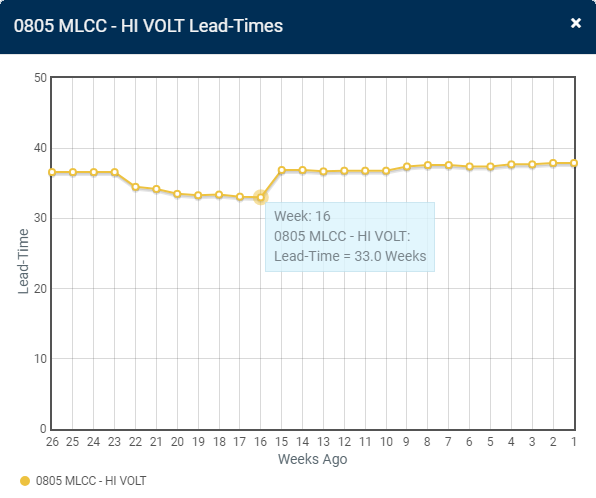 0805 MLCC - HI VOLT Lead Time Trends
Our objective is to limit the amount of disruption that can come from not knowing the lead time for a product by providing this information for all of our buyers and site visitors to see. To that end, we regularly update lead times and take pride in keeping buyers informed on current trends in the market. If you have any questions about lead times, products, or related inquiries, please call our customer support at 1-877-645-4884.