Pronounced shaat·kee dai·owd
Schottky diodes (SDs) are a class of semiconductor diode that are valued for their unique semiconductor-metal junction. Often referred to as a Schottky barrier diode or hot-carrier diode, Schottky diodes increase energy efficiency and improve performance in high-frequency circuits. They are embedded in cell phones, laptops and solar-powered applications.
German physicist Walter H. Schottky, a pioneer in solid-state physics and electronics, laid the theoretical groundwork for SDs in the early 20th century. His work on the Schottky barrier and metal-semiconductor junctions paved the way for the future development these electronic components.
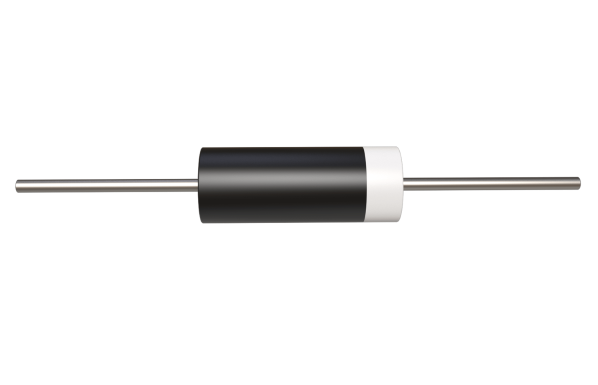
Schottky Diode Structure & Functionality
SDs are created by connecting a metal end, which serves as the positive anode, to a silicon end which acts as the negative cathode. When both ends join they form a Schottky barrier, which controls how electricity flows through the diode.
Schottky diode anodes are constructed from metal materials such as aluminum, chromium, gold, molybdenum, platinum, silicide, or tungsten. In contrast, conventional silicon diodes use a combination of two types of silicon for their anode and cathode.
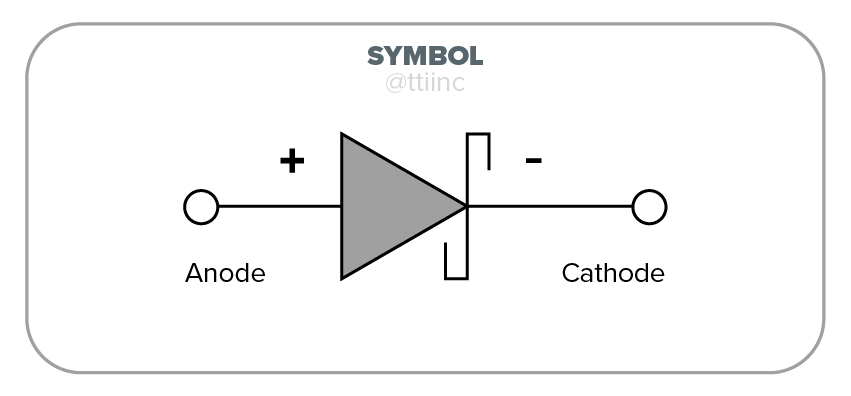
One characteristic of SDs is the ability to function like an on-off switch for electric current used as a rectification tool. When SDs are switched 'on', which is forward bias, they allow current to flow from the metal to the silicon. This is because of the positive voltage applied to the metal enhances the current flow through the device. When SDs are turned 'off', or in reverse bias, they prevent the current from flowing in the opposite direction.
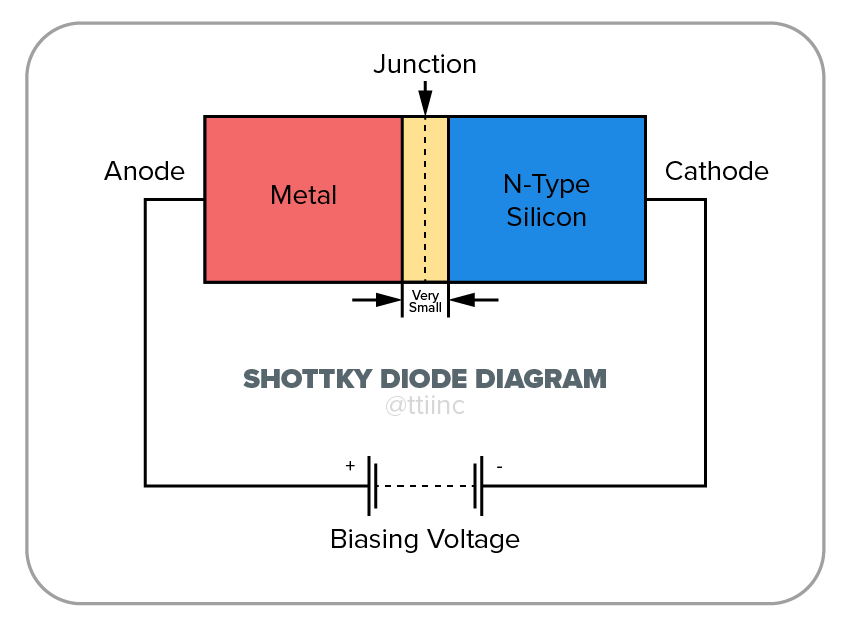
Another important aspect of SDs is the Schottky barrier height determined by the metal used for the anode. This barrier height influences how easily current flows during forward bias. You can think of it as the height electrons must overcome. Different metals create barriers of varying heights. These hieghts make some diodes more suitable for specific tasks. For example, a diode with a higher barrier height may require more voltage to conduct.
SDs prevent unwanted current leakage in applications where efficiency and leakage control are important. However, each SD has its limitations. SDs have a maximum current they can handle when 'on' and a maximum reverse voltage they can withstand when 'off'. Exceeding these limits can damage the SDs, resulting in an electrical fault.
The unique fast switching speed of SDs leads to less power consumption and quicker signal handling due to the special connection between the metal and silicon. The junction's size causes a minimal reverse recovery time. This recovery is the duration of time SDs stop conducting and start blocking current.
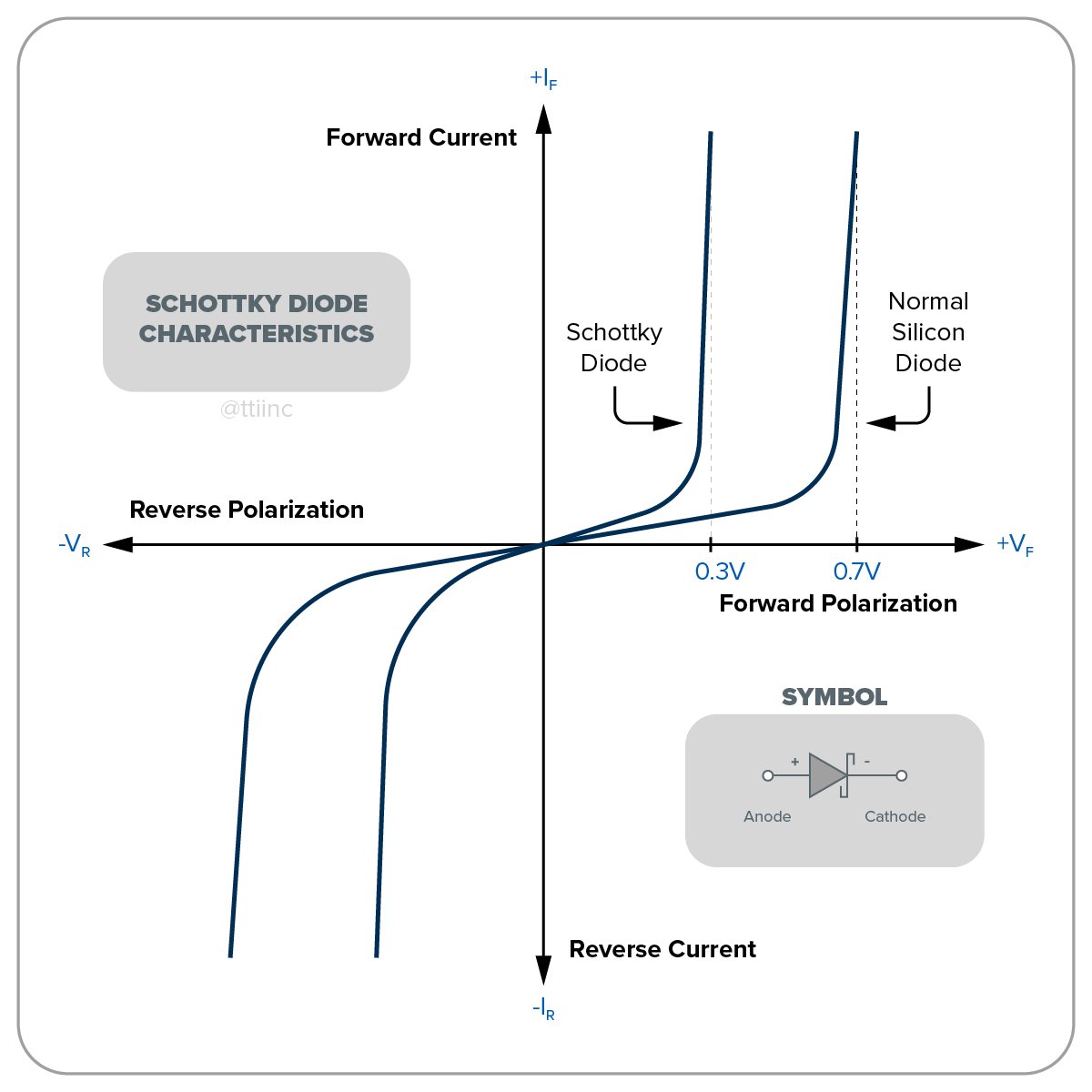
It's important to note that all diodes exhibit a forward voltage drop necessary to turn the diode 'on' and allow current to flow freely. SDs have a lower forward voltage drop than conventional silicon diodes because they require less voltage and less power to activate. SDs need only about 150 to 450 mV of power, significantly less than the 600 - 700 mV required by conventional silicon diodes.
The minimal energy wasted by SDs as heat is due to their low forward voltage drop. This means SDs do not overheat when electricity passes through and conserv power. SDs are also adept at managing the maximum power allowed before overheating due to their power dissipation capacity. SDs efficiently dissipate heat with their thermal resistance. This ability is how SDs resist heat flow and maintain a lower operating temperature.
Schottky Diode vs. Conventional Diodes
Printables
Download Letter Size (11"x11")
Download Poster Size (18"x24")
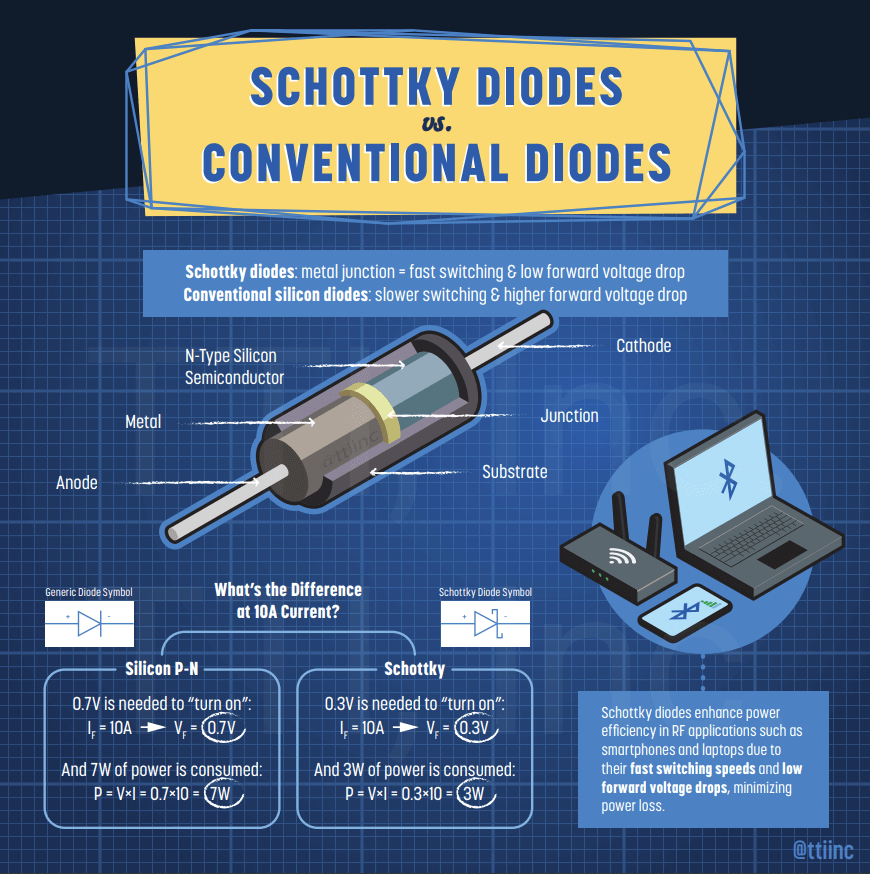
This Infographic explains the differences between SDs and conventional silicon P-N junction diodes. These differences include SD's metal-semiconductor junction for fast switching speeds and low forward voltage drop for applications with high-frequencies. In contrast, silicon P-N junction diodes typically have slower switching speeds, high reverse breakdown voltages and greater forward voltage drops. Silicon P-N junction diodes also have trouble handling high frequencies and allowing more current to flow backward before it's blocked off.
Depending on the application, SDs only require about 0.3V to turn 'on'. Silicon P-N junction diodes require approximately 0.7V to turn 'on' or conduct in the forward direction. This difference in forward voltage drop can significantly impact efficiency and power consumption in specific applications.
A significant disadvantage of SDs is their reverse leakage current. This occurs because SDs are designed with a metal-semiconductor junction with a lower barrier. This lower barrier makes it easier for electrons to slip through as the SD heats up. This is not an immediate problem but think of it like a tiny water leak. While the leakage current itself will not worsen over time. The overall condition of the SD could deteriorate under excessive stress and potentially posing challenges in circuits where minimal leakage is critical.
The leakage might sometimes be overlooked since SDs require less energy to operate. In contrast, silicon P-N junction diodes have a higher barrier for electron flow that results in lower leakage currents. Essentially, the difference in leakage between SDs and conventional silicon P-N junction diodes comes down to how each is constructed.
When choosing between Schottky and conventional silicon P-N junction diodes it's important to consider design requirements such as voltage, current, frequency, power, temperature, noise and cost for the intended application.
Testing Schottky Diodes
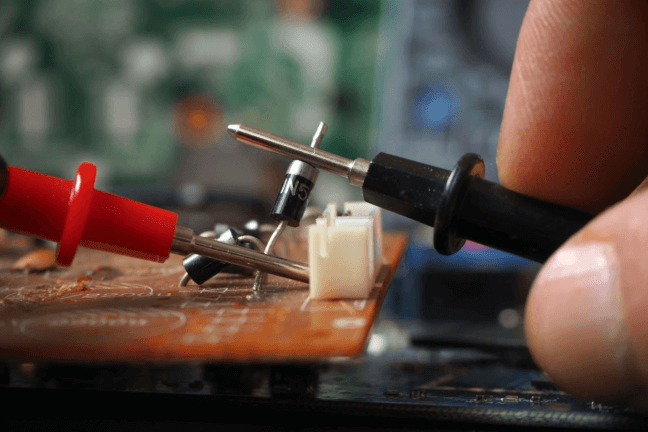
Testing SDs with a multimeter is essential for electrical repairs, maintenance and DIY projects. Multimeters measure various electrical properties, including resistance, voltage and current, typically in Ohms. Before testing, ensure that the power supply to the circuit containing the SD is disconnected. This prevents current from flowing through the multimeter which could potentially cause malfunction or permanent damage to the device.
Connect the anode of the SD to the red positive test lead and the cathode to the black common test lead. When properly connected, multimeters produce a “buzz” or “beep” to indicate a stable connection. You should check for a low resistance reading which confirms that the forward-biased connection is functioning properly. If no sound or low reading is produced the Schottky diode might not be functioning properly.
To retest the SD fully, reverse the connection by swapping the red and black test leads. If no sound is produced when the leads are reversed it suggests that the SD is working correctly.
An expected voltage drop across a typical SD is usually between 0.15V and 0.45V, whereas silicon P-N junction diodes typically have a drop between 0.6V to 1.7V.
Schottky Diode Applications & Examples
SDs' unique properties make them ideal for various applications. SDs' ability to switch with a low forward voltage drop protects sensitive electronics by limiting voltage spikes in power supplies and voltage clamping. Their efficiency in converting AC to DC is also crucial for power rectification in laptop and phone chargers. SDs support RF applications, including radar systems, radio receivers and microwave ovens. SDs also aid in energy-sensitive devices like solar inverters and EVs due to their low power loss and heat dissipation benefits.
Radio Frequency (RF) Mixers and Detectors: SDs, known for their fast switching speeds and high-frequency capabilities, are important in radio frequency applications for minimizing power loss.
- Smartphones incorporate RF mixers that use the metal-semiconductor junction of SDs in power detectors and mixer circuits. This enhances the efficiency of cellular, Wi-Fi, and Bluetooth communications.
Power Rectifiers: Boasting high current density and a low forward voltage drop, SDs reduce heat and enhance efficiency. This makes them ideal for high-efficiency power supplies.
- TVs rely on SDs to efficiently rectify AC power, ensuring a stable DC output with minimal energy loss.
Solar Cells: The low forward voltage drop characteristic of SDs prevents reverse current flow from batteries back to solar panels during the night or periods of low light. This safeguards stored energy.
- Solar-powered outdoor lights incorporate SDs to prevent the stored energy in the battery from discharging at night, thereby maintaining optimal energy utilization.
 Smartphones use Schottky diodes for efficient communication
 TVs use Schottky diodes to reduce energy loss
 Solar lights use Schottky diodes to sustain energy
Looking to buy a particular Schottky Diode?
If you have any questions, call TTI’s customer support at (877) 645–4884.